66
66


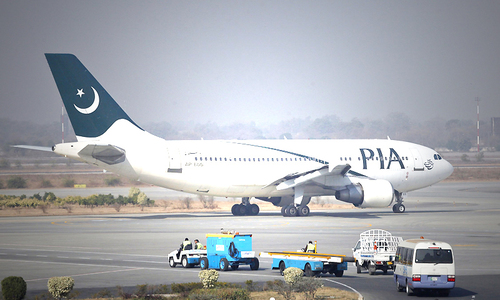
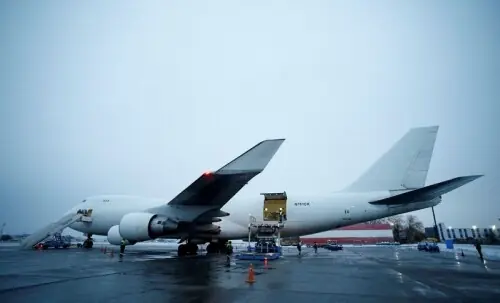
ISLAMABAD: Employees of the ailing national airline on Tuesday walked out in protest over its planned privatisation, disrupting flights and undermining a central plank of reforms promised by Prime Minister Nawaz Sharif in return for an International Monetary Fund (IMF) bailout.
In September 2013, the IMF agreed to lend $6.7 billion over three years in order to save the country from possible default.
In return, the government of Pakistan agreed to broaden its tax base, cut electricity subsidies and privatise failing state companies that lose taxpayers around $5 billion a year.
Soliciting buyer interest in Pakistan International Airlines (PIA), whose accumulated losses stand at $2.29 billion, by December 31, is one of the major steps Islamabad needs to take for the programme to continue.
But the government is struggling to meet that deadline after a delay of many months in amending a 1956 law that bars PIA from being privately owned.
On December 5, the government issued a presidential decree to turn the national flag carrier into a limited company.
The PIA workers are demanding that the Ordinance should be retracted. Meanwhile, the political opponents accuse the government of bypassing parliament by opting for a decree over an amendment that would require lawmakers to vote.
PIA spokesman Daniyal Gilani said airline offices, including reservation booths, remained closed through Tuesday and pilots had joined the strike.
“The employees have a right to strike, but management has requested them not to disrupt flights,” he said.
Chairman of the privatisation commission, Mohammad Zubair, told Reuters the government had informed union representatives that advertisements for PIA's sale would be published on December 31, “no matter what”.
“Despite some delays, the authorities' privatisation and restructuring programme continues to move forward,” IMF's Mission Chief for Pakistan, Harald Finger, told Reuters.
Delicate tightrope
Once a source of pride for the country, PIA flights are now regularly cancelled and many of its aircraft have been cannibalised to keep others flying.
The government has sought to address fears that its sale would lead to big redundancies.
“No employee of PIA will be laid off during privatisation,” Finance Minister Ishaq Dar told reporters last week, a promise economists consider unrealistic given that at least two-thirds of the airline's staff are surplus to requirements, according to the privatisation commission.
In 2013, Zubair said that Pakistan would fetch up to $5 billion in privatisation revenue in two years to raise capital for an economy crippled by years of power shortages, corruption and militant violence.
Two years later, his commission has managed to raise $1.7 billion.
Technically, privatisation falls under the privatisation commission, but officials and analysts say Dar exerts tight control over all finance-related decisions.
“On the one hand, there is privatisation which is an exceedingly delicate tightrope to walk, and on the other, you have clumsy, indelicate people like Dar doing the walking,” said leading business columnist Khurram Husain.
Dar declined requests for an interview to discuss the privatisation programme.
Fierce resistance to privatisation by opposition parties and labour unions has made the programme politically sensitive, as the case of Pakistan Steel Mills, a behemoth with reported losses of $1.42 billion, shows.
In November, after being informed by officials that the bleeding enterprise would barely fetch $100 million against an expected $900 million, Dar decided to hand it over to the provincial government in Sindh where it is headquartered.
“This is such an ad hoc manner to deal with a problematic entity, without any sense of the big picture,” Husain said.
“You can't have major economic decision-making coloured by political considerations like this,” He added.
But the government says the strikes against PIA's privatisation mean it has finally succeeded in doing what previous governments have for decades failed to.
“Government after government has talked about finally taking care of this (PIA) problem and now we are doing it. This shows our political will,” Zubair said.
“Let's not make this process unnecessarily controversial,” Zubair asserted.