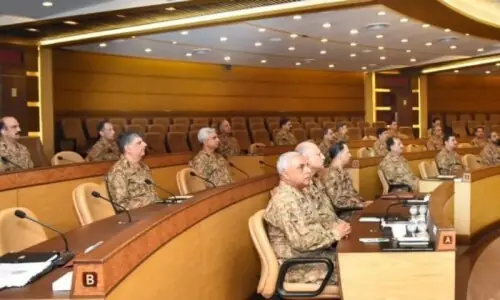
Roughly 45 years after the India-Pakistan competition spread to the nuclear domain, the National Command Authority of Pakistan, the apex nuclear programme-related policymaking body, has declared that it is “the national resolve to maintain ‘Full Spectrum Deterrence Capability’ in line with the dictates of ‘Credible Minimum Deterrence’ to deter all forms of aggression”.
Triggered by Indian intervention in what is now Bangladesh in 1970-71 and then turbocharged by India’s so-called peaceful nuclear explosion of 1974, the nuclear competition between South Asia’s two largest countries has insensibly reached the point where the Pakistani security establishment has firmly committed itself to full-spectrum deterrence — in layman’s terms, Pakistan is committed to developing a range of nuclear weapons and delivery systems that can be used to defend against any possible convention or nuclear attack by India.
Know more: Broadest deterrence capability to be kept
While the outside world has been critical of the Pakistani nuclear evolution, the security establishment here has insisted — with some degree of credibility — that the Pakistani response has been developed in view of India’s expanding military capabilities and the mooting of offensive military doctrines such as Cold Start.
In particular, the Pakistani security establishment points to two threat trajectories: one; India’s rapidly growing military budget is a deliberate attempt to unacceptably widen the conventional military gap between the two countries; and two, India’s latent growth capacity in the nuclear arena could be quickly actualised if it chooses to switch nuclear fuel production from civilian to military purposes at several nuclear installations.
Focusing on a potential rival’s capabilities and not intentions is the core of military preparedness and that logic becomes all the more powerful when the rivalry appears to be growing rather than being nudged towards the normalisation of ties.
It is here where perhaps the greatest challenge lies — the logic of nuclear and military expansion on both sides of the border, a worrying trend if ever there has been one, can only be countered by a powerful peace lobby that seeks to normalise ties between the two countries on the basis of equality and mutual respect.
The security arguments of the warriors on both sides of the border notwithstanding, it is a fact that Pakistan and India are home to two largely poor populations that lack access to basic health, education and job opportunities.
Pakistan needs to be kept safe — but so does its population need to be healthy, educated and productive. The same applies to India. Both countries have so much more to gain by engaging each other in trade, economic and social ties than keeping erect the wall that has been built between the two.
As India has learned with China, so it can learn with Pakistan: economic cooperation can exist side by side with strategic and security-related rivalries.
Unhappily, Indian Prime Minister Narendra Modi appears determined not to talk to Pakistan for now. Perhaps common sense will prevail and a peace process will be resumed at the earliest.
Published in Dawn, September 11th, 2015
On a mobile phone? Get the Dawn Mobile App: Apple Store | Google Play