|
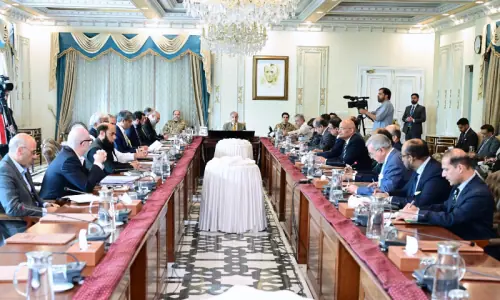
| RAWALPINDI: Prime Minister Nawaz Sharif chairs the National Command Authority’s meeting here on Wednesday.—INP |
ISLAMABAD: The National Command Authority (NCA) concluded on Wednesday that India’s rapidly growing nuclear programme and absence of a conflict resolution mechanism were upsetting strategic stability in the region and the situation was compelling Pakistan to maintain ‘full-spectrum deterrence capability’.
According to ISPR, the apex policy-making body for the country’s strategic programme reviewed in its meeting the regional security environment and was briefed on fast-paced strategic and conventional capability developments taking place in the neighbourhood.
Contrary to international estimates which give a watered down view, Pakistani assessment is that India has enough fissile material, both reactor- and weapon-grade plutonium, for more than 2,000 warheads.
A paper published by the International Institute of Strategic Studies this year noted: “New Delhi’s plutonium stocks also continue to pile up; according to one Pakistani assessment, by the end of 2013 India had produced enough weapons- and reactor-grade plutonium (0.8-1tn and 15tn respectively) for 2,000 warheads.”
The NCA’s reference to the speed with which India is developing its nuclear programme follows reports by US think tanks Carnegie Endowment for International Peace and the Stimson Centre which said Pakistan had the fastest growing nuclear programme and could have the third largest nuclear stockpile within five to 10 years.
The concerns expressed by the NCA also pertained to India’s growing strategic capabilities in the form of new weapon systems including submarine-launchable, intercontinental and medium-range ballistic missiles and improvements in its ballistic missile defence. There are no estimates available on Indian missile inventories.
The NCA also noted with concern India’s rapidly expanding conventional military asymmetry and dangerous limited conventional war policy called Cold Start doctrine.
Relations between Pakistan and India have been on a steep downslide since the Bharatiya Janata Party government came into power in New Delhi last year. The bilateral dialogue on disputes has been suspended since January 2013, while escalating skirmishes along the Kashmir Line of Control and Working Boundary have fuelled tensions. There have been indications from Pakistani defence circles that India could be planning an incursion -- something which was also reflected in Chief of Army Staff Gen Raheel Sharif’s Defence Day speech in which he said that Pakistan was ready for both “cold or hot start”.
“The NCA re-affirmed that the state remains fully cognisant of the evolving security dynamics of South Asia and will take all measures to safeguard its national security,” the military’s public relations wing said.
It said the NCA resolved to maintain full-spectrum deterrence capability in line with the dictates of credible minimum deterrence against all forms of aggression.
MESSAGE OF PEACE: “Pakistan seeks peace and strategic stability in South Asia as cornerstone of its policy and considers conflict resolution as the means to achieving this end,” the NCA said.
Pakistan has been pointing out the absence of a conflict-resolution mechanism as a complicating factor and believes that it is must not only for peace and strategic stability in the region but also for economic development.
The NCA said that Pakistan, being a responsible nuclear state, would remain actively engaged with the international community on nuclear stability and security issues.
“Pakistan shares the goals of non-proliferation and is committed to play its due role as a mainstream partner in the global non-proliferation regimes,” the statement said, adding that the meeting renewed the interest in joining the multilateral export-control regimes on a non-discriminatory basis; including membership of the Nuclear Suppliers Group.
The meeting was presided over by Prime Minister Nawaz Sharif and attended by Defence Minister Khawaja Asif, Finance Minister Ishaq Dar, Interior Minister Chaudhry Nisar, Adviser on National Security and Foreign Affairs Sartaj Aziz, Joint Chiefs of Staff Committee Chairman Gen Rashad Mehmood, the three services chiefs and the director general of the strategic plans division.
Published in Dawn, September 10th, 2015
On a mobile phone? Get the Dawn Mobile App: Apple Store | Google Play