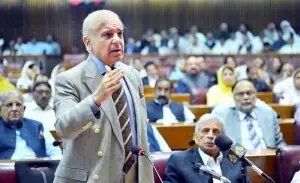
INTERIOR Minister Mohsin Naqvi’s speech at a business summit on Thursday has stirred a hornet’s nest. His diagnosis that the present system of governance is collapsing is correct. His call for political parties to sit together and resolve the country’s issues is welcome — although it will depend on the extent to which the government is willing to engage opposition parties. His warning that business as usual will neither deliver prosperity, nor create jobs, nor fix governance failures is also timely. But his proposed cure — creating smaller provinces on administrative grounds — rests on the flawed assumption that such an exercise will automatically bring the government closer to citizens and resolve governance problems. This view is questionable. From time to time, different political parties, including the PPP, PML-N and MQM, have advocated new provinces for different reasons. Indeed, there is no harm in having a national debate to see whether a consensus can emerge. But it must be an inclusive, evidence-based and unrushed process, based on genuine and broad public participation. The exercise would require scrutiny inside and outside parliament, with a focus on economic viability, administrative capacity and resource distribution.
While the debate on new provinces should continue, there is a much simpler and more effective option available. The aims of devolution, better governance and administrative efficiency can be achieved by constitutionally guaranteeing the continuity of local governments as the effective third tier of governance at the centre and in the provinces. The issue is the failure to devolve political, administrative and financial authority to the local level, where public services are actually delivered. The problem is, no political party is prepared to empower elected LGs. That must change in order to facilitate decentralisation and good governance for a robust economy. New provinces were not the only governance reform the minister, who is considered close to the security establishment, appeared to advocate. He also, rather slyly, hinted at the ‘need’ to build support for an alternative system of governance within the democratic dispensation that would replace the existing federal parliamentary system. Given the serious internal and external threats facing the country, those in authority must refrain from making the parliamentary system, on which the nation has broadly agreed, contentious, as doing so would only strengthen divisive forces.
Published in Dawn, August 1st, 2026