0
0
Inner dimension of Faiz’s poetry
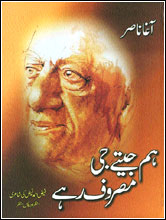
 Told with ease and elegance, Agha Nasir’s Hum Jeetay Ji Masroof Rahay is a kind of biodata of Faiz Ahmad Faiz’s one hundred poems, like they were living beings with a soul, offspring of the poet’s passing liaisons and abiding relationships with life. It is a ground-breaking work, a record of those inspiring moments, touching events, shocking happenings, tragic situations, unexpected encounters and dalliances of the heart that moved the great poet to give us some of his most memorable poems. And for once, mercifully, it is not the run of the mill critique of his art but the drama of the poet’s interaction with the world of his time and its transformation in his hands into throbbing testimonies of unalterable history.
Agha Nasir intended to write this book when Faiz Sahib was alive and had actually discussed his plan with him. He had liked and approved the idea. But before the work could be taken in hand Faiz Sahib died. Yet Agha Nasir did not abandon the plan and decided to collect necessary information from his friends and family, the poet’s own writings and the published material of other writers. It was a difficult enterprise to begin, and as it often happens, one takes one’s time and is pushed to such undertakings only in desperation when it seems if one didn’t do it now, it would never be done. Agha Nasir had this feeling when one by one the friends and contemporaries of the poet started to depart from the scene. But once begun the work became a labour of love.
Agha Nasir introduces his book as a different kind of work since it is neither a critical review of Faiz Sahib’s poetry, nor a commentary on his political and national attitudes and philosophy of life or either his biographical or personal sketch, though where needed, all these elements do get a brief mention. The one hundred poems which he has selected to annotate them with their historical, situational or emotional background have been grouped under 17 headings according to events in the country’s and the ebbs and tides in the poet’s life. Yeh dagh dagh ujala comes under ‘national events’, shishon ka masiha koi nahin under ‘political circumstances’, Hum ke thehre ajnabi under ‘fall of Dhaka’, Dashte tanhaee mein under ‘moments of loneliness’ and so on and so forth.
The poignant occasion when Faiz Sahib recited Yeh dagh dagh ujala has been described in the words of Dr Aftab Ahmad: “The partition of the Subcontinent was announced on 3rd June. After a few days the summer vacations began. I went to Kashmir with my family. In the beginning of August we came to Srinagar and took residence in a house boat. Across the river in a bungalow the families of M.D. Taseer and Faiz Sahib were putting up. Two or three days after the 14th of August Faiz Sahib also arrived. I met him the next day at Taseer Sahib’s place. Bashir Hashmi and Dr Nazir Ahmad were also there. Faiz Sahib, with some hesitation which would heighten in the presence of elders, told us that a poem he had begun in Lahore was completed while on way to Srinagar. On Taseer Sahib’s asking he read this poem for the first time.”
Agha Nasir also describes how this greatest of Faiz’s poem was criticized both by the progressives, critics of the Left and the poets and writers of the Right wing. How could the dawn of freedom be described as a ‘sullied or tarnished morning’ they barked ignoring, what Prof Fateh Muhammad Malik said, Faiz Sahib’s deep love for his country reflected in the poem.
 On the fifth anniversary of independence Faiz Sahib was incarcerated in Hyderabad jail. Describing the festive arrangements in the prison he wrote to Ellis it felt as if they were not in jail but in Anarkali Bazaar. “Next morning I woke up with a strange feeling of joy and I immediately sat down to write, which I am sending you with this letter. I was much surprised that it took no time to write and by breakfast time I had nearly completed it. I am still drunk with it and have some apprehension that I might some day become a poet.”
This was the occasion of that great and popular poem Nisar mein teri galyon pe ay watan ke jahan. After the death of the Quaid-i-Azam and Liaquat Ali Khan’s martyrdom all sincere and patriotic leaders had dispersed and the country had become a centre of intrigues, writes Agha Nasir. Malik Ghulam Mohammad had become the governor general through palatial conspiracies and Khwaja Nazimuddin was too weak a prime minister to stop the decline. Seeing it all from behind the walls of the Hyderabad jail Faiz captured the national rot in the lines of this poem.
During the days behind the bars Faiz Sahib also composed some poems and ghazals to give heart to his jail mates who later admitted that what gave them the courage to go through confinement were those verses of his, in particular the famous tarana: aye khak nashinon uth baitho who waqt qareeb aa pohncha hai/ jab takht giraey jaen ge, jab taj uchhale jaen ge. Ellis also wrote about it and said it was the poet’s most favourite composition in qawwali form.
Aaj bazaar mein pa ba jolan chalo was written in 1959 when he was sent handcuffed in a tonga from the Lahore central jail to see his dentist. A procession of admirers followed the poet who was moved by the people’s love. Mujh se pehli si muhabbat meray mehboob na maang marks his break with the romantic past in Lahore and his induction into Left politics on the prodding of Dr Rashid Jahan in Amritsar. The poem also refers to his infatuation with a Kashmiri beauty and disappointment in love. He confessed that to Amrita Pritum and Zehra Nigah.
I.A. Rahman, in his thought-provoking preface to the book, describes the integration of verse to history as an enviable feat as it very concisely recounts the bedevilled story of Pakistan also, that Faiz Sahib had, in a humourous vein, predicted to continue without suffering any change. As to apprehensions that bridging the ‘disconnect’ between event and verse would somehow limit the impersonal expanse of Faiz’s poetry by particularising it, is a somewhat fancy thought to me. Dante’s unrequited love for Beatrice gives the Divine Comedy its soaring altitude. Agha Nasir has traced an inner dimension of Faiz’s work, shown the man the poet was; what he felt and thought.