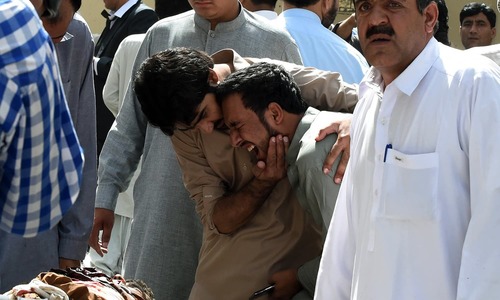
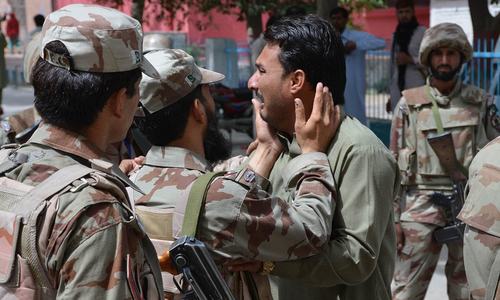
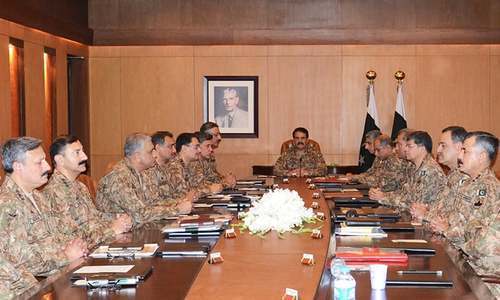
The tragic attacks in Quetta have led to a vicious war of words wherein some politicians have attacked ‘external enemies’, while others trained their guns on the ‘enemy inside’.
For example, soon after the attack, Balochistan Chief Minister Sanaullah Zehri accused India’s RAW of being involved in the Quetta terrorist attack.
Before people had gotten over his statement, Mehmood Khan Achakzai, whose Pakhtunkhwa Milli Awami Party (PkMAP) is part of the Balochistan government, said it was convenient to point fingers at foreign hands instead of putting one’s own house in order, words that were clearly aimed at the Pakistan military.
The veteran Pakhtun leader unequivocally criticised the intelligence agencies in particular and the armed forces in general, for not doing enough to check terrorism.
He was not alone.
Maulana Mohammad Khan Sheerani of the JUI-F also accused the security establishment for being mercenaries, fighting an “American war” against its own people for “dollars” in the shape of Coalition Support Funds.
Maulana Sheerani, who heads the Council of Islamic Ideology, then went further and held the military establishment responsible for the current state of affairs in Pakistan.
These two politicians did not make these accusations during a talk show or a public rally, but inside the hallowed halls of the National Assembly.
It seemed as if the senseless violence in Quetta unleashed pent up anger elsewhere. Once politicians begin a war, television commentators jump in before long.
Soon enough, anchorpersons and media personalities too, jumped in to criticise the army. One anchor even questioned the army chief’s presence in the provincial capital after the attack.
However, the ‘other side’ wasn’t spared either. Others targeted the ruling PML-N for its pro-India policy and not taking a tough stand against RAW and other foreign elements, including Afghanistan’s NDS.
Unfortunately, though Pakistan has suffered devastating attacks in the past too, somehow the verbal attacks which follow seem particularly internecine and vicious now. It is as if polarisation within the state and society has reached new heights.
Although the government and others from the PPP and PTI tried to appreciate the military’s efforts in a bid to gloss over the criticism of earlier days, it still left many wondering.
For some, the answer is simple – the military dominates the project to eradicate militancy and as a result, it comes in for criticism if and when an attack happens.
“Balochistan has literally been under the military establishment’s control. Who else would be held responsible for this massacre,” asked one observer.
Another senior political analyst felt that tension between the civilians and the military was the reason behind this rhetoric.
“Everyone is talking about the civil military gap. In such a scenario, the respective supporting elements have also aligned themselves accordingly and given the opportunity, come out openly.
An academic also lent weight to this argument by pointing out that some private news TV channels could be categorised as pro-government while others were pro-army.
“Each of them has created a narrative which suits their side and it becomes shriller at a time of crisis.”
However, politicians obviously use this occasion also to score political points.
For an opposition politician, this ‘division’ was Prime Minister Nawaz Sharif’s fault, who “is known to pick fights with the military establishment”.
“The difference between the 1990s and the present day is the media. Now, with 24/7 media coverage, people know what is happening behind closed doors whereas in the past, people only found out when something big happened.”
Those who are part of the government place the blame elsewhere; a member of the federal cabinet said that the military establishment was in complete control in certain areas for which it had to take responsibility.
The minister felt that Mr Achakzai’s had been unnecessarily played up. “He perhaps could have used different words and there would have been less of an outcry; otherwise, all he spoke about was accountability.”
Published in Dawn, August 12th, 2016