5
5
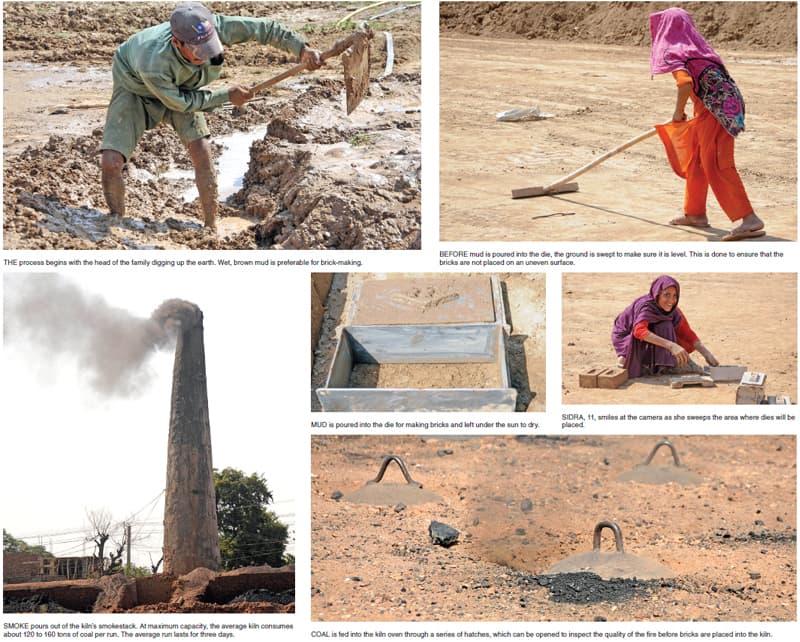
Working from dawn to dusk has become routine for 11-year-old Sidra Khan. Even though she should not be working under law, Sidra has been toiling away at a brick kiln near Islamabad for several years now. Her parents and other siblings are also employed by owner of the kiln in Tarnol.
“We make about 1,000 bricks a day and are paid Rs700. We start work around Fajr time and continue until Maghreb prayers; there is no break in the middle. In return, our employer provides us accommodation and daily wages.”
Sidra has never been to school, because it has never been a priority for her family. She told Dawn that the kiln-owner employed three families. Her family seemed reluctant to speak to outsiders, but said they had come here from Peshawar, looking for work. There are also several other children, working in over 20 brick kilns in the area, in a bid to support their impoverished families. For these children, learning the art of brick-making is worth far more than an education. But in contrast to their efforts in other parts of the country, neither the government nor civil society organisations seem to be interested in the plight of these children or in the implementation of child labour laws, which are being flouted by these kiln owners.
“We never force anyone to bring their children to make bricks. Most families utilise adult men and women in the hopes of increasing their income,” says Abdullah Khan, the owner of the brick kiln. He told Dawn the services of the entire family were hired because they lived and worked in the kiln full-time and worked better than ordinary labourers. He denied the impression that child labour or forced labour was being carried out, at least in his area.
“As for the children’s education is concerned, it is a personal matter for the families themselves. We have never stopped them from sending their children to school,” he said. Brick-making is hot and hard work and children and older people have to work extra hard. First, the head of the family selects the earth for making the bricks. Brown soil is preferable, and the rest of the family begins by digging it out and preparing it with their feet, a process which they have dubbed “dancing in the mud”. The mud is left for the day and covered with plastic sheets before, the next day, workers shape the dough-like mud and pour it into iron die for shaping into bricks. The bricks that are prepared are then dried under the sun for three days and then put in the kiln for baking. Once exposed to the searing heat of the kiln, they are ready to go to the market.
 |
 |
Published in Dawn, September 13th, 2015
On a mobile phone? Get the Dawn Mobile App: Apple Store | Google Play