KARACHI, June 8: Civil society groups can play a more effective role in the formulation of policies if they are equipped with basic knowledge about legislative process and parliamentary rules and procedures, observed a representative of the Strengthening Democracy through Parliamentary Development (SDPD) on Friday.
Unless rights organisations had an understanding of various stages of legislation, they could not efficiently save interest of people by timely advocating for or against a bill, said SDPD representative Aslam Brohi at the concluding session of a two-day workshop.
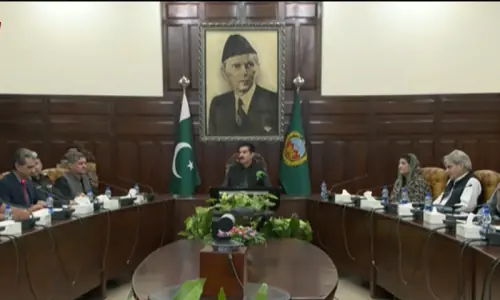
The Senate of Pakistan had collaborated with the UNDP to bring together over 30 representatives from different civil society organisations, including the Human Rights Commission of Pakistan, Pakistan, Pakistan Institute of Labour Education and Research, Banh Beli, Aurat Foundation, Hope and Indus Resource Centre, at the workshop.
During the session, former joint secretary (legislation) in the senate and retired judge Mohammad Ashraf Chaudhry introduced the participants to legislative bills, their types, the procedure to introduce a bill, the role of standing committees, clause by clause consideration of a bill, how to propose amendments and pass a bill into law before it’s sent to the other house for approval and then to the president for his assent. The timeframe for approval and the powers of the president to return the bill with suggested changes to a joint session for consideration and final voting.
Mr Chaudhry said that even parliamentarians were sometimes unaware of the details of a bill despite having its copies with them while passing it.
He cited the example of a retired army officer who voted in favour of a bill in the senate but got worried at a later stage when he learnt that the legislation allowed withdrawal of some medical facilities previously provided to senators.
The participants were of the opinion that awareness and training programmes should be arranged for lawmakers to assist the senate, national and provincial assemblies in building their capacity to perform more efficiently and also for the youth to understand and play their due role in the legislative business.
They also called for holding interactive sessions between civil society and lawmakers to ensure better work on required legislation, which would consequently strengthen the democracy in the country.
Earlier on the first day of the workshop, SDPD National Technical Adviser Jamil Ahmad Qureshi gave a detailed presentation on legislative history, covering the military rules and ordinances issued during that time.