CM Murad voices concern over delays in Karachi Circular Railway revival
• Believes long-awaited transport scheme should have become operational long ago
• Says governor’s rule, emergency in KP can’t be ruled out
• Leaves for China on five-day official visit
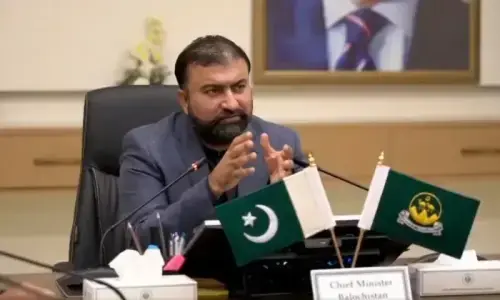
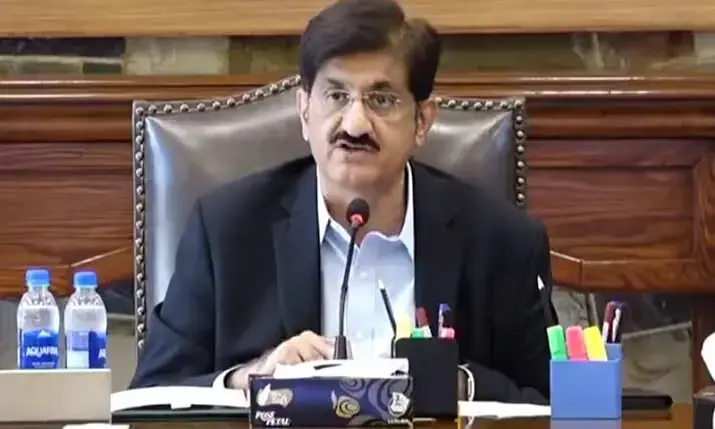
SUKKUR: Sindh Chief Minister Murad Ali Shah has voiced concern over delays in Karachi Circular Railway (KCR) revival, saying the project should have become operational a long time ago.
Talking to reporters at Sukkur airport before going to Khairpur on Saturday, he said Chinese officials had previously assured Pakistan of their support for the project, but it was side-lined during a previous federal government, resulting in delays.
He also expressed dissatisfaction with the level of support provided by the federal government for the revival of the project, saying Sindh had not received the assistance the key transport scheme warranted.
The Sindh government had approached the Asian Development Bank for $21 billion financial assistance to revive the KCR project.
The KCR was included in the China-Pakistan Economic Corridor (CPEC) in December 2016 at the request of the Sindh government. However, the Pakistan Tehreek-i-Insaf (PTI) government had opted to revive it on a build-operate-transfer basis under a public-private partnership model, with heavy subsidies for the private partner. That plan was later abandoned by the subsequent PDM-led government, which shifted back to seeking Chinese investment under CPEC.
However, the project continued to face delays and even a planned visit by the Sindh CM to China for financial and technical assistance in September 2025 never materialised.
The chief minister said despite these challenges, the provincial government remained committed to development initiatives that served both Sindh and Pakistan, citing Thar coal as an example of a project contributing to national energy security.
He said the provincial government would continue to pursue infrastructure and development projects despite financial and administrative constraints.
‘Governor’s rule at KP’
He said that the possibility of imposing governor’s rule or an emergency in Khyber Pakhtunkhwa (KP) had not yet been ruled out.
He urged the PTI leadership to reconsider its political approach and avoid creating circumstances that could lead to such a situation.
He said the PPP would never support an unconstitutional move and hoped that no situation would arise requiring such an intervention.
“Governor’s rule is not something we would consider appropriate as the chief minister of a province,” he said, adding that the PPP wanted to avoid any such development.
However, Mr Shah alleged that the KP government was pursuing a course of action that was alienating stakeholders and escalating tensions, potentially creating circumstances in which the authorities might feel compelled to take an extraordinary step.
Referring to PPP Chairman Bilawal Bhutto-Zardari’s recent remarks on the issue, he said the party hoped that JUI-F chief Maulana Fazlur Rehman would succeed in his efforts to prevent such a situation.
He urged PTI leaders to seriously consider the direction in which they were taking the country, particularly at a time when Pakistan was facing serious security challenges and the threat of terrorism.
‘No wheat shortage’
The chief minister said Sindh had sufficient wheat stocks to maintain supplies and stabilise flour prices, dismissing the impression that the province was facing a shortage of the essential commodity.
He said the provincial government had been working for the past two to three months to ensure wheat procurement, including completing purchases that had remained outstanding in previous periods.
He acknowledged that flour prices had risen to between Rs150 and Rs160 per kilogram but attributed the increase to a combination of domestic factors and international developments.
Mr Shah said rising petrol and diesel prices had increased transportation and freight costs, contributing to higher prices. Regional and international conditions had also affected the market, he added.
The chief minister maintained that the government had adequate stocks and would take steps to keep prices stable.
‘Visit to China’
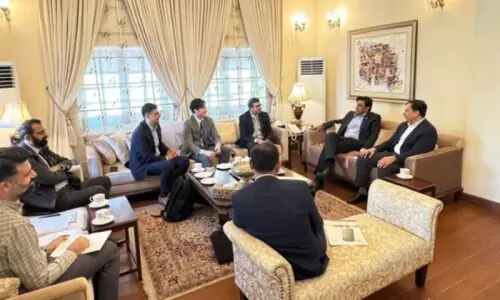
The chief minister, who later in the evening left for China from Karachi airport on a five-day official visit, said his visit was expected to open new avenues for investment and cooperation in Sindh.
He said 15 provincial government projects had been approved by the Sindh cabinet and memorandums of understanding (MoUs) would be pursued in areas including infrastructure, cloud computing and artificial intelligence.
Published in Dawn, October 11th, 2026