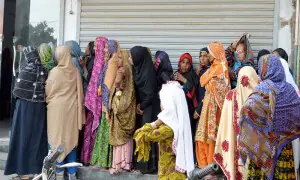
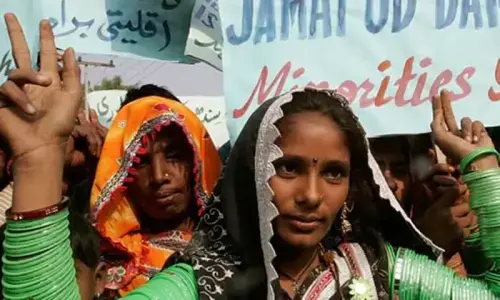
NARDARAN, Azerbaijan: A woman with her head uncovered is a rare sight in Nardaran, an impoverished village on the Caspian Sea which has become a stronghold of Islamic activism in ex-Soviet Azerbaijan.
Roadside posters offer messages from the Quran, alcohol is absent from local shops, and hundreds of villagers recently took to the streets in protest against a controversial decision to stop girls wearing the Islamic headscarf in schools.
Angry worshippers demonstrated last month outside the huge mosque which dominates the village on the outskirts of the capital, set fire to a photograph of the education minister and chanted: “We'd rather die than give up the hijab!”
The hijab was effectively banned in schools last year by new rules defining what kind of uniforms pupils should wear in this mainly Shia Muslim country, which emerged as one of the most secular in the Islamic world after decades of Soviet rule.
“Azerbaijan is a secular state and this issue is clearly defined by the law on education,” Education Minister Misir Mardanov said last month.
“Observing rules in secondary schools is not in contradiction with being a Muslim.”
In Nardaran, however, many parents were furious.
“The ban on the hijab constitutes a violation of religious rights,” declared one villager, Hikmet Aliyev.
The head imam at the local mosque, Adalat Alizade, said the attempt to interfere with what he called “divine law” was forcing believers into conflict with the state.
“I do not want to be secular; I am a religious person,” Alizade said.
“Yes, I will observe the laws of Azerbaijan, but when certain laws are in conflict with religion, then I will give preference to religious laws.”
In prosperous downtown Baku, which has been enjoying an economic boom due to Azerbaijan's huge oil and gas revenues, young women often wear Western-style fashions and short skirts are as common as hijabs.
One parent in the capital, housewife Gulnara Akhmedova, said that although she is religious, she also believes that schoolgirls are too young to decide for themselves whether to wear the hijab or not.
“A woman who covers her head should take the decision about the hijab on her own, but children are often forced to wear the hijab and they basically don't understand what it means,” Akhmedova said.
“All this leads to fanaticism,” she warned.
Islam has been enjoying a revival since Azerbaijan became independent from the Soviet Union, and the authorities have imposed restrictions on religious worship and detained Muslim radicals in an attempt to prevent the spread of extremism.
But Ilgar Ibrahimoglu, a liberal cleric and religious rights campaigner, alleged that the pious were being persecuted.
“Some people within the government are suffering from a phobia about religion and are therefore trying to restrict the freedom of religion,” he said.
Hundreds of Muslims also demonstrated against the hijab ban outside the Education Ministry in Baku last month, and more discontent is likely, Ibrahimoglu warned.
“Restrictions on human rights naturally provoke internal protest,” the cleric said.
Education Minister Mardanov has suggested that outside forces were involved in stirring up the recent demonstrations — a veiled reference to neighbouring Iran.
Azerbaijan has uneasy relations with its Islamic neighbour, and in a US diplomatic cable released by WikiLeaks last year, President Ilham Aliyev allegedly accused Tehran of financing radical religious groups in his country.
A senior Iranian cleric, Grand Ayatollah Naser Makarem Shirazi, has condemned the hijab ban as “anti-Islamic”, although the Iranian foreign ministry has described the issue as “Azerbaijan's internal affair”.
The authorities insist that the new rules will remain in force, but in Nardaran, local resident Hikmet Aliyev said that schoolgirls would continue to wear headscarves whatever the education ministry said — setting the scene for potential future conflict. “The authorities can do nothing because we, the whole village, are against the ban, and they can't force our girls to go to school bare-headed,” Aliyev said.