



 0
0

 ISLAMABAD, Aug 1: As the announcement for a flight leaving for Karachi is made, Anwer Maqsood, takes you to what a literary critic would term as the willing suspension of disbelief, towards a picture showing the Quaid-i-Azam, standing along with Allama Iqbal and Maulana Mohammad Ali Jauher at the modern-day Islamabad airport. A small girl comes running to the Quaid and asks for his autograph. As the girl is about to leave, Maulana Jauher stops the girl and asks her as to how did she recognize the great leader. “It’s the mummy who did it. She asked me to get the autograph of Christopher Lee before he emplanes,” said she. (Alluding to the actor playing Quaid in the recent film made on him).
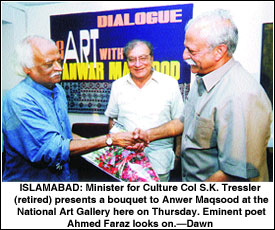
Only an Anwer Maqsood can do it with his inimitable wit; and, indeed he did display his pithy, Oscar Wilde-like remarks in plenty at a house packed with “people of substance”, (as somebody described the audience) at the “Dialogue on Art” with him at the National Art Gallery, organized by the Pakistan National Council of the Arts. You may try to present him as a painter, which of course he is, in his own right. “I used to live in the vicinity of painter Shakir Ali in a housing area known as PIB Colony in Karachi in my childhood and would draw lines with charcoal on the walls, and Shakir Ali would say, ‘now that you know how to draw lines you should also fill them with colour’”. You may highlight Anwar Maqsood as a dramatist, an intellectual and whatever else, but one fact that permeates his entire personality is reflected in all his achievements is his consummate skill as a writer and presenter of wit that takes you beyond the inner recesses of your soul. It is a sense of humour born out of vision of what he sincerely believes we as a nation should have been, and still can be if we make a genuine attempt to make them as our founder fathers saw it for our piyare watan.
Only an Anwer Maqsood can tell you “everything is right with Pakistani art, otherwise people in uniform would have taken it over to correct it. And it is only an Anwer Maqsood who can say that during the last 55 years of our history the one good news is Pakistan winning the World Cup in cricket. And it is only an Anwer Maqsood who can portray Maulana Mohammed Ali Jauher having a VCR, and when somebody asks him, why he is keeping it, he replies that he was doing it because somebody had given him a cassette of the Best of Shaukat Ali, which in fact are recordings from the Pakistani singer Shaukat Ali.
Anwer Maqsood receives letters from the other world from people like Ghalib, Iqbal and Quaid-i-Azam, and portrays modern situations through their eyes. He can say all this and much more because his wit is not born of rancour; it comes out of what an American writer Faulkner would probably term as writing the problems of the human heart in conflict with itself.
He may talk on modern art, he may list all the big artists and painters and their movements. He may talk of Pakistani artists and their greatness, and the fact that their fake pictures are now being sold in plenty (an artist told me that Ahmed Pervez is selling by the hundreds but nobody wants to buy my pictures. When Anwer Maqsood told him that Pervez is a great name, he said that he is making all these fake pictures from Pervez). But all the time you sense his sense of humour which keeps them alive in an entirely new manner, something that you always wish him to do. Juxtaposing the sordid with the glorious (Ghalib saying that people are lifting car, while in our days people would not even lift the misras of other poets) is a technique that he uses with a technical virtuosity very few people writing or expressing orally can afford to claim. (Iqbal telling him in imagination that he was known as poet of the East, now he has been confined to being a poet of one country, while the master of wit adding that what greater honour can there be for a poet to be associated with the very identity of a country.
People of substance, said Changez Sultan of the PNC in his introduction, have come to listen to a man of substance, and one found a whole lot of writers, poets, artists, painters and intellectuals listening with rapt attention to a person who not only came out with terse sentences, but also did not indulge in a long monologue. Luckily the dialogue, unusual for a literary meeting of this kind almost started on time. One could see poet Ahmad Faraz and Kishwar Naheed there, while Col Tressler who said that he did not come as the chief guest but as an admirer of the artist.—By Mufti Jamiluddin Ahmed





























