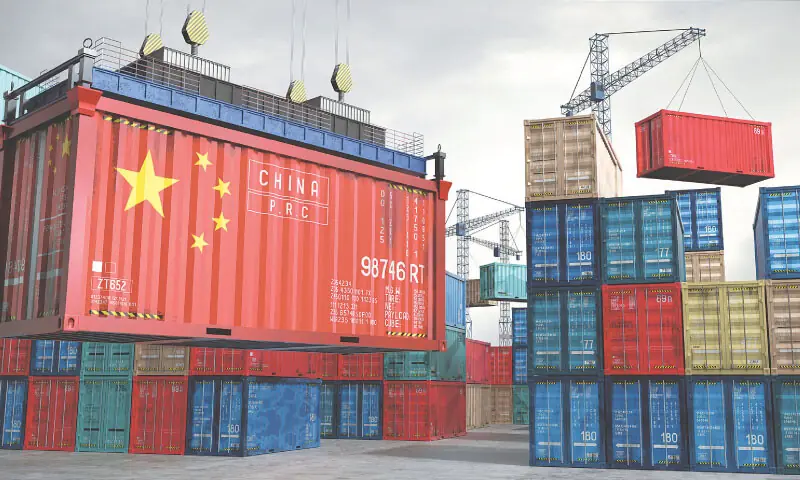
Few claims in Pakistan’s economic debate are repeated with more confidence than this: the free trade agreement with China flooded the country with cheap goods and destroyed local industry. The data tell a more complicated story. Pakistan depends on Chinese goods more than its neighbours do. But the agreement did not start that dependence, cheap consumer goods are not where most of the damage lies, and the costliest decisions were taken in Islamabad.
The China-Pakistan Free Trade Agreement took effect in July 2007; a second phase has been in force since January 2020. In 2025, Pakistan imported $20.5 billion from China, 31 per cent of all its imports, and sold China just $2.3bn. The $18.2bn deficit was a record and more than half of Pakistan’s entire trade deficit. In 2013, China accounted for about a fifth of that deficit.
Against the size of Pakistan’s industry, the exposure is unusual. According to China’s own figures, Chinese goods other than machinery accounted for 32pc of Pakistan’s manufacturing value added in 2022, compared with 21pc for Bangladesh and 14pc for India.
But the timing does not fit the popular story. That ratio nearly tripled before the agreement existed, from 4.7pc in 2000 to 12.5pc in 2006. It averaged 18pc in the agreement’s first seven years and 29pc in 2014–18. Nothing in the tariff schedule changed in 2014. The exchange rate did. The rupee’s real effective rate rose by more than 13pc to 2017, and the International Monetary Fund judged the currency overvalued by up to 20pc: a subsidy to imports from everywhere.
Domestic policies, under-invoicing, and the exchange rate are more to blame than the free trade agreement
Between 2013 and 2017 the deficit with China widened from $4bn to $13.9bn. Machinery for China-Pakistan Economic Corridor projects accounted for $4.6bn of that. But the deficit excluding machinery nearly quintupled, from $1.4bn to $6.7bn. That was the overvalued rupee at work. Machinery dependence also predates the corridor: China’s share of Pakistan’s machinery imports rose from 16pc in 2006 to 40pc in 2013 and 66pc in 2023. Since then the deficit has tracked the economic cycle, peaking at $17.6bn in the credit-fuelled boom of 2021.
What of the cheap consumer goods at the heart of the complaint? Here the case is weakest. Their share of China’s exports to Pakistan has not risen since the agreement. In 2025, Pakistan’s largest imports from China were semiconductor devices, chiefly solar panels, worth $1.95bn, and telephone equipment worth $1.79bn. Pakistan has no solar panel industry to displace, and the phone imports are mostly kits for local assembly: in the first half of 2024, 17.34 million handsets were assembled at home against 0.84m imported. Furniture, glassware, footwear and toys are each worth about $200m a year or less.
The share of China’s consumer goods exports to Pakistan has not risen since the agreement; in 2025, Pakistan’s largest imports from China were semiconductor devices, chiefly solar panels, worth $1.95bn and telephone equipment worth $1.79bn
Where consumer goods do hurt, it is through under-invoicing. China reports shipping far more to Pakistan than Pakistan records receiving, about $7bn more in 2022, and more than two-fifths of the gap since 2003 is in consumer goods. Under-invoicing pays only where duties are high, on the goods the agreement left protected. A Gujarat fan maker is undercut not by a lawful tariff preference but by goods clearing Karachi port at a fraction of their value. That is a failure of Pakistan Customs.
The real injury lies upstream. Theresa Chaudhry of the Lahore School of Economics found that in sectors where Pakistan cut tariffs on Chinese goods, productivity and value added fell relative to others. Yet the sharpest recent blow was domestic. The Finance Act 2024 withdrew sales-tax zero-rating on local supplies to exporters while imported yarn stayed tax-free, handing foreign spinners an18pc advantage. The All Pakistan Textile Mills Association says more than 100 spinning mills, nearly 40pc of capacity, have shut.
The promise of access to China’s market was squandered too. Pakistan signed for less than China had already granted to the Association of Southeast Asian Nations two years earlier, a sign of a negotiation run with little preparation or one in which diplomacy trumped trade. Comparable terms came only in 2020. Exports to China peaked at $2.65bn in 2013 and were still only $2.29bn in 2025, mostly copper, cotton, fish and ores.
Nor was Pakistan singled out: since 2006, China’s exports to Bangladesh and India, which have no trade agreement with China, have grown faster than its exports to Pakistan. Vietnam shows what a competitive economy does with Chinese inputs. It absorbs Chinese goods other than machinery equal to 72pc of its manufacturing value added, yet its exports equal 90pc of national output. Pakistan’s are barely 10pc.
Pakistan’s lack of competitiveness is largely home-made: power shortfalls that cost industrial cities 12–37pc of output, investment falling from over 15pc of national output to 10pc, a rupee held overvalued and tariffs that make selling at home more profitable than exporting.
The remedies lie at home. Close the customs gap through real-time data exchange with China and publication of the gap product by product. Tax local and imported inputs alike. Invoke the second phase’s safeguards where harm is documented. Build professional negotiating capacity, with published impact assessments. And stop managing the rupee for political convenience.
A country that cannot keep its lights on, sets its currency for political convenience, and lets goods clear its ports under-declared will struggle against China, with or without a trade deal. Cheap Chinese goods are not the real problem. Islamabad’s policies are.
The writer is the former head of Citigroup’s emerging markets investments and author of ‘The Gathering Storm’.
Published in Dawn, The Business and Finance Weekly, October 12th, 2026