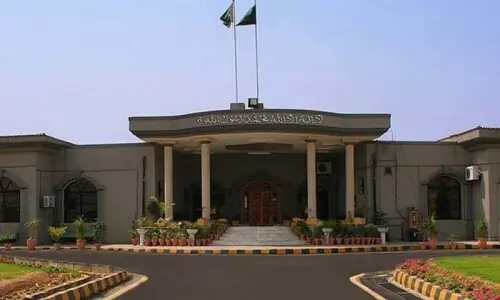
ISLAMABAD: The Federal Constitutional Court (FCC) on Wednesday ruled that earlier Supreme Court and Islamabad High Court (IHC) decisions that led to the demolition of Monal Restaurant and other commercial establishments within the Margalla Hills National Park (MHNP) constituted an exceptional transgression of judicial power that resulted in a grave miscarriage of justice.
In a written order, a three-judge FCC bench, which had issued a verbal order on Monday, accepted review petitions filed by the Capital Development Authority (CDA) and the Metropolitan Corporation Islamabad (MCI), challenging the Supreme Court’s Aug 21, 2024, directives. In that judgement, the apex court had held that any lease, licence, allotment or permission granted for restaurant operations within the protected MHNP was contrary to the Islamabad Wildlife Ordinance, 1979, and therefore had no legal effect.
The ruling paved the way for the closure of Monal, La Montana and Gloria Jean’s restaurants, and the subsequent demolition of their infrastructure to protect the park’s biodiversity.
Headed by Justice Syed Hasan Azhar Rizvi, the bench, also comprising Justice Aamer Farooq and Justice Syed Arshad Hussain Shah, held that questions relating to the entitlement to or ownership of the restaurant site, its lease to the Monal Group of Companies, and the recovery of rent involved disputed questions of fact requiring adjudication by a competent civil court after allowing the parties to present their evidence.
Written order asks civil court to decide lease dispute
The short order, for which detailed reasons will be issued later, also set aside the Supreme Court’s Aug 21 finding that any lease, licence, allotment or permission granted by the CDA, the Remount, Veterinary and Farms Directorate, General Headquarters, Quartermaster General (QMG) Branch, Rawalpindi, or any other department or authority for operating restaurants within the MHNP was contrary to the Wildlife (Protection, Preservation, Conservation and Management) Ordinance, 1979.
The FCC held that the MHNP forms an integral part of the Islamabad Capital Territory (ICT) and is therefore subject to the laws, rules and regulations applicable to the federal capital. Consequently, the approval of any construction plan or building activity for public purposes within the MHNP falls within the statutory jurisdiction of the CDA.
Accordingly, the court ruled that the Supreme Court’s findings entitling the Islamabad Wildlife Management Board to withdraw rent deposited by the respondent for the preservation, conservation and proper management of the MHNP, and to regulate certain activities within the park by issuing licences, were contrary to law and therefore stood annulled. As a result, all matters relating to the administration of the MHNP are to be regulated by the CDA in accordance with the applicable laws, rules and regulations.
The FCC directed the concerned civil court to consolidate the pending suits and proceed from the stage at which they had earlier stood.
However, it allowed the plaintiffs to file fresh applications for interim relief concerning the subject property before the trial court at any appropriate stage. Such applications, the FCC said, should be decided in accordance with the law without being influenced by the judgments or orders previously passed by the Supreme Court, the IHC, the district judge or any earlier orders.
After deciding the interim applications, the civil court was directed to dispose of the consolidated suits expeditiously on their merits after providing all parties with an equal, fair and adequate opportunity to present their evidence.
The FCC held that once the Supreme Court judgment had been reviewed, every consequential or derivative judgment founded upon it, including the review judgment, could not survive independently and must also fall.
The court regretted that, while deciding interlocutory proceedings arising from pending civil suits, the Supreme Court had recorded findings of a final and conclusive nature on issues that properly fell within the exclusive jurisdiction of the civil court.
It observed that those findings not only prejudged the disputes pending before the civil court but also adversely affected the rights and liabilities of several persons who were neither parties to the proceedings nor afforded an opportunity of being heard, as required under Article 10-A of the Constitution.
The FCC further noted that the prejudice was compounded during the review proceedings, where the present petitioners, the CDA and the MCI, despite being directly affected by the Aug 21 judgment, were not given an effective opportunity to present their case. A judgment affecting the rights of persons who have not been heard cannot ordinarily be permitted to attain finality merely because it has been pronounced by the highest court, the FCC ruled.
Published in Dawn, July 16th, 2026