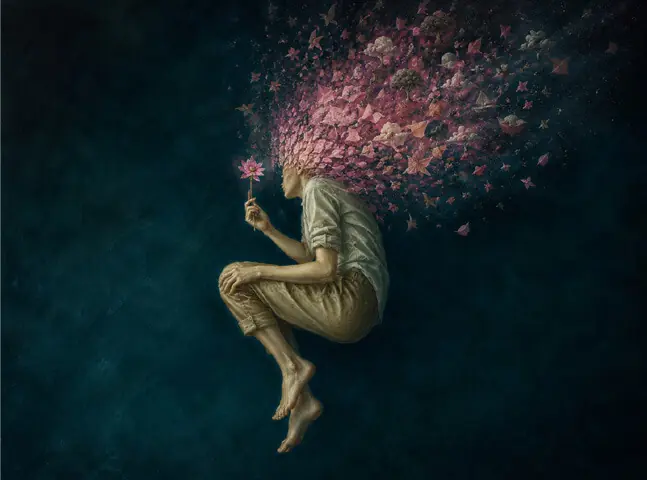
In Borges’ short story ‘Funes the Memorious’, a boy named Ireneo Funes is thrown from a half-tamed horse. The fall leaves him paralysed for the rest of his short life — and, in the same stroke, leaves him able to remember everything. Not the important things. Everything. Every cloud he has seen, every leaf, every crack in every wall, every change in a face, every hour in its full and unbearable detail.
For the rest of us, memory is a broken lantern. It lights a few corners and leaves the rest mercifully dark. For Funes, it is a floodlight. Nothing escapes it, nothing fades, nothing is softened by distance.
This sounds at first like a gift. We treat forgetting as weakness. Students want sharper memories, the old fear losing names, nations raise monuments so the past will not dissolve into dust. Memory is virtue. Forgetting is betrayal.
Borges ruins the comfort. Funes does not grow wise; he grows trapped. Before the fall he had been an ordinary boy, the kind who could tell the hour exactly without a clock. Now, lying paralysed in the dark — because light and detail have become unbearable — he cannot reduce the world into usable shapes. He cannot easily think “a dog”, because a dog seen in profile at 3:14 is not, to him, the same creature as the dog seen from the front a minute later. Each glance is its own kingdom. Each second demands its own throne.
Remembering everything would be a curse and would become overwhelming. But we must also guard against the oldest trick of power: telling us what and who to forget
His verdict is plain: to think is to forget differences, to generalise, to abstract. Funes, drowning in particulars, can barely hold a category in his head; replaying one ordinary day in detail takes him a full day to do. This describes more than one strange boy. It describes how every working mind survives. We do not carry the world whole. We edit it down to something we can use. And the man who cannot edit, cannot move. Total memory and total paralysis are, for Funes, the same affliction.
But Funes is only half the parable. The other half is what separates his curse from ordinary cruelty: he never chose it. Here, Funes becomes useful beyond literature, because we edit our feelings exactly as we edit our thoughts. We cannot feel for everyone; no heart was built for it. So we ration the feeling — a great deal to a few, a little to many, and nothing at all to most. That rationing is the wiring itself, older than any choice we believe we are making.
A person who actually felt the world’s pain in full would not become a saint. He would become Funes. He would feel everything and, like Funes, be unable to move.
There is simply too much of it. That is the scandal under existence — not only that people suffer, but that the suffering outruns the capacity of any single conscience. You wake, open a phone and, inside a minute, you are handed a famine, a massacre, a flood, a bankruptcy, a war advertised as virtue — all somewhere between a toothpaste advert and a cricket meme. No nervous system was built for this. Certainly not ours, which still panics at an electricity bill and an unknown number ringing at night.
So we abstract. We say “Gaza”, “Sudan”, “Kashmir”, “the poor”, “the refugees”, “the farmers.” The words are not lies. They are compressions. They fold millions of separate lives into a category because, without the category, we would go under. This is the same editing that lets us think at all. The wiring rations feeling; power decides who gets the ration.
So the question is not whether our empathy is selective. It always is. The question is who trained the selection — and, once it is trained, who has been left outside it altogether. Who receives the feeling, and who receives nothing at all?
Why does one child’s death become a global symbol while another becomes “complex geopolitics”? Why does one refugee read as human and the next as a demographic problem? Why is a bombing in one city an attack on civilisation, and the same act elsewhere reported like weather?
This is where the editing turns dangerous. A child becomes a “civilian casualty.” A village becomes a “target area.” Hunger becomes “food insecurity.” A sacked workforce becomes “cost optimisation.” The dead become a number, the number a chart, the chart a policy — and the policy, freshly bathed and wearing a tie, leaves the graveyard without once smelling the bodies.
This is the oldest trick of power and the quietest. It rarely asks us to hate the victim; hatred is loud and it leaves evidence. It asks only that we not picture him too clearly. Do not picture the father with the bag of medicine he cannot pay for. Do not picture the man who built the mall but is turned away at its doors. Keep them statistical. Keep them far enough to manage.
Empathy, in other words, gets organised. Some suffering is given a biography; other suffering is denied even a vocabulary; and some lives are moved quietly to the far side of feeling, met not with less sympathy but with none. To feel nothing for the living is not a lapse of degree; it is a border drawn through the species, with people standing on the wrong side of it.
Funes is the warning at the far end. Total detail destroyed his thought and his body; total abstraction destroys our conscience. A decent life moves between them — enough abstraction to act, enough particularity to stay human. We need the word “war” to grasp the scale and the face of one child to know what it means. We need the word “poverty” to argue policy and the memory of a man who says he has already eaten so his daughter can have the last roti.
But notice the difference between Funes and the men who run the world. Funes could not choose. His curse was involuntary; paralysed in the dark, he would have given anything to forget. The powerful are not cursed. They are practised. They have learnt exactly which lantern to carry and exactly where to point it — whose dead to count and whose to round off, whose ruins to mourn and whose to explain.
There is a real mercy in forgetting. Without it, grief would freeze us; every small happiness would feel stolen; every cup of tea would be interrupted by the knowledge that, somewhere, a life is being taken apart. And there is a real cruelty in it, because the comfortable cultivate it, the powerful depend on it and the screen sells it back to us by the hour.
Perhaps the task is not to feel everything; that is beyond us. The task is to grow suspicious of our own obedience — to ask why the heart moves fast for some and slow for others, to notice which grief has been made familiar and which made foreign, and to refuse the quiet instruction that turns a human being into background noise.
We cannot hold the whole world in our chest. But we can refuse to let power decide whose pain deserves a name.
The writer is an essayist concerned
with power, politics and culture.
He can be contacted
at suhaib.ayaz@gmail.com
Published in Dawn, EOS, July 12th, 2026