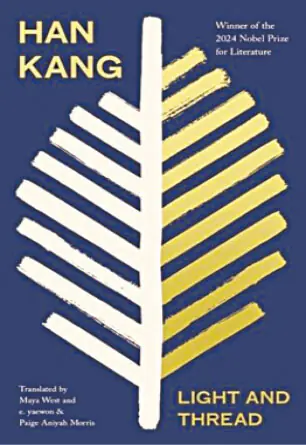
Light and Thread
By Han Kang
Penguin Uk
ISBN: 978-0241817018
176pp.
Some authors are surrounded by a halo of celebrity that lends them an air of unquestionable authority, rendering them practically untouchable. More often than not, this breed of writers has either clinched prestigious awards or rendered great services to the hallowed halls of literature. As a result, their reputation seems to precede them, thereby shaping readers’ perceptions of their work.
After she won the Nobel Prize for Literature in 2024, South Korean novelist Han Kang has joined this charmed circle of literary heavyweights. When she was declared the winner of the coveted award, the global literary intelligentsia lauded the Swedish Academy’s efforts to circumvent Eurocentric biases and recognise a non-Anglophone voice. Kang is the first South Korean, as well as the first female Asian, to bag the honour.
Since then, her oeuvre has witnessed a striking resurgence. Book clubs across the world, particularly, have taken a keen interest in her International Booker Prize-winning novel The Vegetarian. The novel features a graphic designer named Yeong-hye who stops eating meat after being assailed by troubling nightmares of animal slaughter.
Unsurprisingly, Light and Thread — Kang’s first book since her Nobel win — has been released under the full glare of publicity. However, readers weren’t expecting a collection of essays, poems and diary entries from an author whose fiction examines humanity’s unrelenting capacity for compassion and brutality.
A slim collection of reflective essays, poems and diary entries by the Nobel prize winning author Han Kang offers a behind-the-scenes glimpse into what it means to put pen to paper
A radical departure from her kaleidoscopic fictional offerings, Light and Thread is a more intimate, reflective text. At its core, this slim compilation — translated by Maya West, E. Yaewon and Paige Aniyah Morris — offers a behind-the-scenes glimpse into what it means to put pen to paper in a dark, dismal world steeped in injustice. Fuelled by a disarming honesty, this slender volume is welcome proof that the South Korean novelist isn’t fazed by her celebrity status.
The compilation begins with Kang’s eponymously titled Nobel lecture, translated into English by Yaewon and Morris. Sceptics might view the decision to include this piece as a self-congratulatory move verging on conceit. Mercifully, the lecture isn’t punctuated with vainglorious details and instead provides a doorway into the author’s fascinating approach to her literary pursuits.
Kang describes the discovery of an old shoebox containing a stack of her journals, one of which is titled ‘A Book of Poems.’ Written when she was eight years old, the notebook includes a hastily scrawled stanza about love as “a golden thread connecting between our hearts.”
The discovery of a lost manuscript inspires her to reflect on the complexities of her creative process. “Each time I work on a novel,” she writes, “I endure [a series of] questions, I live inside them. When I reach the end of these questions — which is not the same as when I find answers to them — is when I reach the end of the writing process.”
Throughout the Nobel Lecture, Kang offers refreshing insights about the philosophical questions that steered her towards certain creative projects. The Vegetarian, she asserts, is rooted in a curiosity about the extent to which human beings are capable of innocence.
The Nobel laureate also examines her creative fascination with the Gwangju Uprising, a series of student-led protests that erupted in South Korea after the coup of May 1980. The historical event finds itself at the emotional core of her celebrated novel, Human Acts. Kang writes of the extensive research she conducted in an effort to evoke the chaos of those times.
She admits to using “all the sensory details of seeing, of listening, of smelling, of tasting, of experiencing tenderness and warmth” when she embarks on the ink-and-paper route. Her sentences, Kang claims, are seeded with “vivid sensations”, as though she were sending signals to readers. Writing, though, is a process assailed by self-doubt, and Kang confesses to feeling a heady mix of astonishment and gratitude when her creative output resonates with readers.
Following this powerful essay, the relatively succinct piece, ‘Even in the Darkest Night’ comes across as somewhat tepid, revealing only a few noteworthy insights. Even so, ‘After Publication’ compensates for this inadequacy by capturing the overpowering sense of relief a writer feels when they complete a project. In this scintillating and deeply rewarding essay, Kang turns an intimate gaze on how the creative process impacts her psyche, leading her to confer distinctly human attributes to the writing process. In addition, this piece raises some pertinent points on how the publishing process tends to bifurcate authors, creating a chasm between their public persona and their private notions of selfhood.
‘Small Teacup’ draws attention to Kang’s writing rituals while she worked on We Do Not Part. Though heavily disadvantaged by its own brevity, the piece offers guidance to some writers who may need to set the mood before they begin filling their canvas with words.
‘North-facing Garden’ and ‘Garden Diary’ are two spiritually interlinked pieces, where the author morphs into a keen observer of flora. This isn’t just any other convenient distraction from the mundane. On the contrary, the exercise helps Kang adopt a fresh outlook to the philosophical questions that have plagued her.
Gardening emerges as a nurturing act that mirrors the world-building process to which fiction writers are accustomed. Kang’s clumsy yet enthusiastic forays into gardening are marred by frequent challenges and a cluster of failed experiments. The essays serve as a lesson to aspiring writers that all creative journeys are filled with obstacles, which can only be surmounted through steely determination.
With each successive essay, it becomes evident that Kang is posing more questions than she is capable of answering. Some readers might view this as a shortcoming, but the compilation appears to be strengthened by the absence of airtight conclusions. The essays in Light and Thread don’t come across as prescriptive declarations from an author who has won the world’s most prestigious literary prize. Instead, they possess the candour and vulnerability we should expect from creative reflections or diary entries.
Publishing these pieces is undoubtedly an act of courage. It is, therefore, refreshing to note that Kang hasn’t allowed her status as a celebrated author to haunt the pages of this compilation. Her self-reflexive essays indicate that she harbours a deep commitment to the written word.
Apart from their readability, the poems in Light and Thread possess a uniquely personal touch, reminding readers that the compilation seeks to reveal hitherto unknown facets of Kang’s creative voyage. As a consequence, the Nobel laureate’s new book comes through as an ode to a rich, nuanced and, at times, enthralling literary life, filled with crests, troughs and occasional detours.
The reviewer is the author of the critically acclaimed novels Typically Tanya and No Funeral for Nazia. X: @TahaKehar
Published in Dawn, Books & Authors, July 12th, 2026