0
0

BRITISH royalty arrange their own funerals long before they die. For Queen Elizabeth the Queen Mother, plans were prepared well in advance of her death in 2002. They were coded ‘Operation Tay Bridge’. In 1997, however, the palace was caught off-guard by the sudden death of Diana, Princess of Wales. They dusted ‘Tay Bridge’ and used it for Diana instead.
Prince Philip’s funeral plans — ‘Operation Forth Bridge’ — were put into motion when he died in 2021. His widow Queen Elizabeth II passed away a year later. Her funeral adhered meticulously to the much-rehearsed ‘Operation London Bridge’.
All three senior royals died of old age. Their deaths came as no surprise, unlike the murder of their kinsman Lord Louis Mountbatten, killed by the IRA in 1979. Mountbatten — a stickler for ceremony — made an elaborate programme (‘Operation Freeman’) which included one representative from every Indian regiment when he was the viceroy there. Prime minister Indira Gandhi scotched his grandiose ideas by reminding him that he was no longer viceroy of India.
Many recall the hastily arranged but dignified funeral of US president John F. Kennedy in 1961 and the heartbreaking image of three-year-old ‘John-John’, saluting his father’s casket. Western funerals leave little room for emotions.
Parades, fireworks and boastful speeches mark nations’ decline.
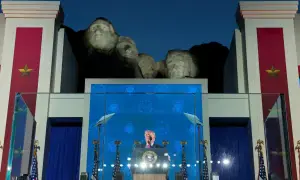
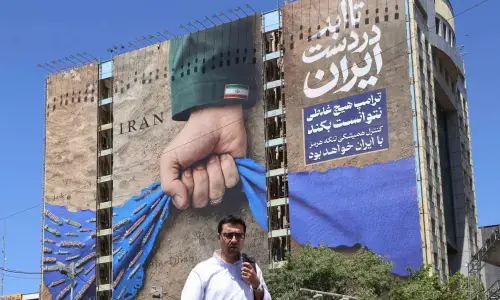
Eastern funerals are different. Hysteria erupted at the funeral of Ayatollah Ruhollah Khomeini in 1989. An estimated 10 million mourners (about one-sixth of Iran’s population) took part. His successor as supreme leader, Imam Ali Khamenei, was killed by US-Israeli forces in an attack on his home in Tehran on Feb 28. With him died his daughter, son-in-law, daughter-in-law and 14-month-old granddaughter. Their bodies remained unburied. On July 4, funeral rites began in Iran. Their coffins, one no larger than a crib, draped in Iran’s national colours, were given a mass farewell. Millions gathered at every stage of the cortege’s procession in Tehran, Qom and (in Iraq) Najaf and Karbala before interment on July 9 in Mashhad. Ayatollah Khamenei’s funeral was deliberately timed with the celebrations across the Atlantic marking the 250th anniversary of America’s independence — a telling rejoinder by an undefeated Iran to Donald Trump’s hubris.
Nations are not given state funerals; parades, fireworks and boastful speeches mark their decline. President Trump may see himself as a modern Caesar. Many of his detractors have already begun sharpening their daggers. His Brutus waits in the wings. Ten years ago, in 2016, during Trump’s first presidential campaign, The Atlantic magazine carried an article by J.D. Vance, who at the time worked in a private sector venture capital firm. He had not entered politics. Vance felt compelled, though, to voice strong opposition to Trump’s candidacy.
Vance described Trump’s political credo as “cultural heroin”, a “needle in America’s collective vein”, offering voters “an easy escape from pain”. Vance grumbled: “Trump never offers details for how these plans will work, because he can’t. To every complex problem, he promises a simple solution.” Vance prayed that one day, Trump’s supporters would realise he wasn’t the answer to their problems.
This month, on July 4, The Atlantic reprinted Vance’s original article. Why did it wait years to remind Vance of his indictment of Trump, and that too on the occasion of the US semiquincentennial? Its editorial explained lamely: “So that our readers can judge for themselves how well [Vance’s] assessment has stood the test of time.” Or perhaps how far Vice President Vance wishes to distance himself from Trump? Vance’s reasons for allowing that re-publication are probably the same as Brutus’s: “Not that I loved Caesar less, but that I loved Rome more.”
Is Vance hoping for a response from US voters in the elections due in November 2028, similar to the cry of Romans in Shakespeare’s play Julius Caesar? Among those who gathered to hear Brutus’s justification for murdering Caesar, one citizen cries out: “Let him be Caesar.” Another tops that with: “Caesar’s better parts/ Shall be crown’d in Brutus.”
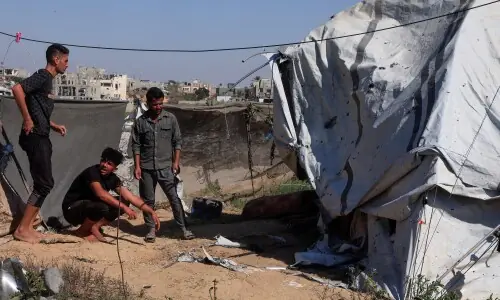
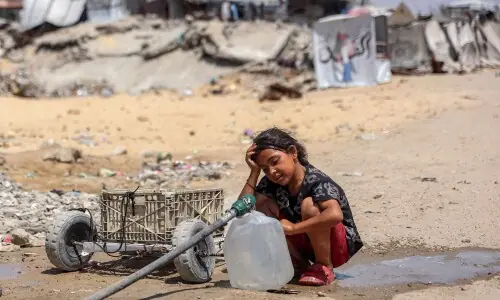
Ayatollah Khamenei’s 14-month-old granddaughter, the 164 defenceless Iranian children evaporated in their elementary school in Minab on Feb 28, and the 20,000-plus Palestinian children slaughtered in Gaza are martyrs to causes they will never reach adulthood to understand.
Khamenei’s funeral bore the official motto: ‘Must rise’. It is an ironic echo of the American poet Maya Angelou’s elegiac lines: “You may write me down in history/ With your bitter, twisted lies,/ You may trod me in the very dirt/ But still, like dust, I’ll rise.”
“Martyrdom does not end something,” the late Indira Gandhi, who died at the hands of assassins, once said, “it is only a beginning.” Such brutal ends spawn dangerous beginnings.
The writer is an author.
Published in Dawn, July 9th, 2026