Cabinet revises appointment criteria for vice chancellors of Sindh universities
• Age limit raised from 62 to 65 ‘to broaden candidate pool’
• Rs515m okayed to provide fuel subsidy to fishermen
• 500 acres allocated for ‘mega’ graveyard in Karachi
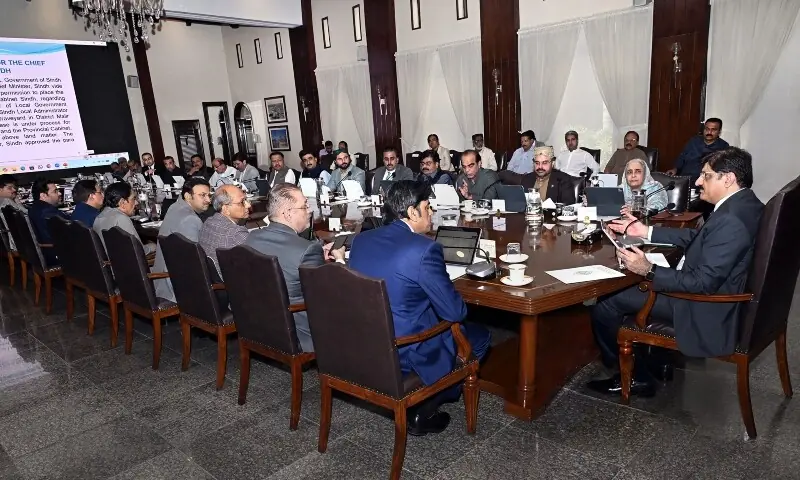
KARACHI: The Sindh cabinet has revised the criteria for the appointment of vice chancellors (VCs) of universities across the province, increasing the maximum age limit by three years to 65.
The cabinet meeting, chaired by Chief Minister Murad Ali Shah, also approved a Rs30 billion development, welfare and reform agenda aimed at improving infrastructure, healthcare, governance, education and public relief across Sindh.
According to a press statement, the cabinet revised the appointment criteria to “modernise the appointment process for vice chancellors to broaden the candidate pool and attract experienced leadership”.
It said that the amendments to the law include that the maximum age for candidates for the post of VC to be raised from 62 years to 65 years for all categories.
The required experience is to be increased from 15 years to 20 years, with a mandatory minimum of 10 publications in the Higher Education Commission-recognised journals.
It may be noted that the Sindh Assembly had already amended the Sindh Universities and Institutes Laws Act under which it allowed a serving or retired bureaucrat to become a candidate for the post of vice chancellor of general universities.
Also, the cabinet approved the draft Recruitment Rules and Service Regulations 2026 for all seven Boards of Intermediate and Secondary Education in Sindh.
Positions such as chairman, secretary, controller of examinations and audit officer will now be filled through a standardised search and selection committee process to ensure meritocracy.
The new rules set the age limit for the chairman (BPS-19/20) at 40-55 years, requiring a Master’s degree (1st Division) and 15 years of senior management experience.
Fuel subsidy for fishermen
The cabinet approved a Rs515 million fuel subsidy package for the province’s fishing community to provide them relief.
According to a press statement, the cabinet was informed that the subsidy for fishermen is designed as a one-time payment covering two months of fuel costs to mitigate the impact of rising diesel prices, which have led to a 20 per cent decline in fish landings and threatened thousands of livelihoods.
Under this scheme, the government will provide targeted support to 9,634 registered boats, with a specific focus on small-scale and coastal operations.
A total of 2,331 small boats measuring 18-24 feet with 20 horsepower (HP) outboard engines will each receive a subsidy of Rs200,000, amounting to a total allocation of Rs466.2m.
A total of 488 boats measuring 10-15 feet with five-10 HP engines will each receive a subsidy of Rs100,000, totalling Rs28.8m.
Fisheries Minister Mohammad Ali Malkani said to ensure complete transparency and audit compliance, the subsidy will be disbursed through a digital process.
Fishermen must complete online registration with the Karachi Fisheries Harbour Authority (KFHA). Once verified, the funds will be paid directly into the bank accounts provided by the boat owners during registration, he added.
Subsidy for bikers
The cabinet also extended till May 31 the Peoples Fuel Subsidy Program to provide continued relief to motorcycle owners.
The CM directed the finance department to release Rs2bn for the month of May to ensure uninterrupted payments to eligible motorcyclists. The cabinet was informed that to date, 548,085 applicants had been paid around Rs1.09bn at the rate of Rs2,000 per motorcyclist.
To protect the livelihoods of low-income drivers and reduce ride cancellations, the cabinet approved a proposal to lower the Sindh Sales Tax (SST) on motorcycle passenger services.
The SST on net fares earned by motorcycle owners/drivers using cab aggregators (such as Bykea) is reduced from 5pc to 2pc. This prospective reduction is expected to have a financial impact of approximately Rs120m per year, the cabinet was told.
A significant sum of Rs6.5bn was approved as grant-in-aid for the Karachi Metropolitan Corporation (KMC) to rehabilitate road infrastructure across 24 Town Municipal Corporations (TMCs).
The cabinet also approved Rs2bn for the S-III project’s sewerage treatment plant in Haroonabad.
Addressing the urgent need for burial space in Karachi, the cabinet approved the reservation of 500 acres of land in Deh Mitha Ghar, District Malir, for a “mega graveyard”.
The area is being earmarked in favour of the local government department.
Bridge on Indus, projects for Hyderabad
The cabinet, on the recommendation of the finance committee, approved a grant for consultancy services for the engineering design of a new 1.12km highway bridge over the Indus between Hyderabad and Kotri, with an estimated cost of Rs147.2m.
The CM said that the bridge would be a great facility for light and heavy traffic travelling to and from the upcountry.
The cabinet approved Rs252.2m for the construction of a graveyard in Hyderabad; Rs800m for laying multiple new water supply pipelines in Qasimabad; Rs800m for the construction of an underpass and a link road at the Qasimabad-Hyderabad Chowk; and Rs500m for the construction of a Sports Complex in Latifabad.
The cabinet approved Rs1.2bn to widen Shaikh Ayaz Road from Sindh Museum to Ali Palace Pumping Station in Hyderabad and to build a drainage system along the route.
The cabinet approved Rs4bn to upgrade the drainage system in Larkana City.
Published in Dawn, May 6th, 2026