

KP sets climate agenda, calls for global cooperation and green economy shift
Climate change is no longer a distant warning. It is a lived reality reshaping weather systems, economies, and human security across the globe. For Pakistan, and particularly for Khyber Pakhtunkhwa, its effects are immediate and intensifying.
The KP Chief Minister noted that the province faces a growing spectrum of climate related risks, including riverine and flash floods, glacial lake outburst floods, prolonged droughts, heatwaves, urban flooding, and the spread of vector borne diseases. He warned that the scale and frequency of these events are expected to increase further, requiring urgent and sustained action.
“Climate change is no longer a distant threat. It is a present and accelerating reality,” the message stated.
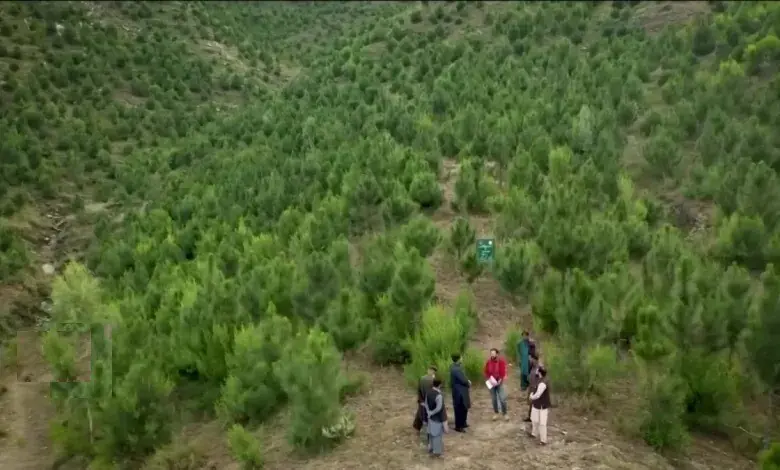
At the same time, the Chief Minister emphasised that vulnerability does not define Khyber Pakhtunkhwa alone. The province, he said, has emerged as a leading example of environmental action in Pakistan, particularly in forest restoration and climate resilience.
“Our forests are not simply natural assets, they are ecological infrastructure that sustains biodiversity, regulates climate systems, and supports livelihoods,” he said.
Recalling progress since 2013, he highlighted large scale afforestation initiatives undertaken under the vision of Imran Khan, including the Billion Tree Afforestation Project and the Ten Billion Tree Programme. According to the message, these efforts have significantly increased forest cover in the province, now exceeding international benchmarks at 26.7 percent of total land area.
Khyber Pakhtunkhwa, he noted, holds nearly 40 to 45 percent of Pakistan’s forests, which absorb a substantial share of national carbon emissions. Sustaining this ecological asset, he stressed, requires long term investment and consistent policy support.
“Since 2017 alone, approximately Rs 675 billion has been invested in forest conservation and expansion,” the message added.
The Chief Minister also outlined a shift in policy direction towards what he termed a green economic model. This approach seeks to link environmental protection with economic opportunity by supporting forest based livelihoods, encouraging community participation, and exploring carbon markets.
He stated that the province’s potential in carbon credits could generate significant annual value, strengthening the case for integrating environmental indicators into fiscal planning frameworks.
“There is a strong case for revisiting the National Finance Commission Award formula to include environmental indicators such as forest cover and carbon credits,” he said.
Referring to international examples, he noted that countries such as India and China already incorporate forest related weightage in fiscal distribution systems.
Alongside forestry, the province is expanding its climate response across multiple sectors, including renewable energy, sustainable agriculture, clean industry, and urban resilience. Measures underway include the transition of brick kilns to cleaner technology, development of an electric vehicle policy, and deployment of air quality monitoring systems.
A province wide Air Quality Improvement Action Plan has been introduced, supported by institutional mechanisms aimed at improving accountability and enforcement. In addition, the Provincial Climate Change Policy provides a structured roadmap for both mitigation and adaptation across infrastructure, health, water systems, and local economies.
Clean energy has also been identified as a key priority. The message highlighted ongoing investment in hydropower and large scale solarisation of public institutions, including schools, hospitals, mosques, government buildings, and households.
At the global level, the Chief Minister stressed the imbalance between responsibility and impact, noting that regions with minimal emissions often face the most severe consequences.
“This imbalance must be addressed through enhanced cooperation, climate finance, and technology transfer, consistent with the principles of the Paris Agreement,” he said.
The Breath Pakistan International Climate Change Conference, organised by Dawn Media, was described as a timely platform for strengthening dialogue between policymakers, experts, and stakeholders.
Concluding his message, the Chief Minister said Khyber Pakhtunkhwa stands ready to continue its role in climate action, but stressed that progress must now accelerate beyond commitments into implementation.
“The task ahead is not to define the problem, it is to accelerate solutions,” he said.
He added that the choices made today will determine the resilience of future generations, calling for clarity, urgency, and collective responsibility in addressing the climate challenge.
This content is produced in paid partnership with the Khyber Pakhtunkhwa (KP) government - a partner of DawnMedia’s Breathe Pakistan initiative.