0
0

US President Donald Trump’s decision to abruptly cancel a previously confirmed visit by his envoys to Islamabad underscores a defining feature of the current crisis: diplomacy that advances and retreats at the speed of presidential messaging.
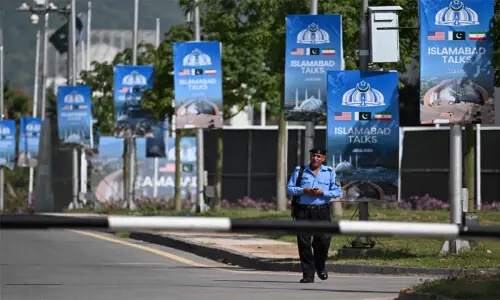
Until this latest move, Washington had been sending mixed but cautiously constructive signals. Backchannel contacts and Pakistan’s mediation had raised the possibility of direct engagement in Islamabad, potentially involving Iranian Foreign Minister Abbas Araghchi.
Mr Trump’s decision to cancel the trip does not formally end the diplomatic track, but it significantly alters its momentum. Instead of actively pursuing negotiations, the burden now shifts to Tehran, effectively placing the onus on Iran to initiate contact on US terms.
US president’s decision to cancel envoys’ trip does not formally end diplomatic track, but it significantly alters its momentum
For mediators like Pakistan, this is a notable setback. Diplomacy thrives on continuity; abrupt reversals complicate both timing and trust.
‘Erratic and provocative’
Iranian officials have long argued that Mr Trump’s public messaging disrupts diplomacy, a concern reflected in Western media coverage.
The Guardian has described Mr Trump’s “erratic and provocative commentary” as “a major obstacle” to diplomacy, noting that such statements can undermine ongoing engagement. The publication has also warned of a broader “lack of a clear exit strategy”, highlighting uncertainty in US policy direction.
The New York Times has frequently noted that President Trump uses social media as an instrument of policymaking, often announcing or shaping decisions in real time.
The Washington Post has reported that his messaging has at times complicated or contradicted official diplomatic positions, while the BBC has highlighted how such statements can move markets and influence global diplomacy.
Analysts across the Western world have pointed to the growing role of presidential messaging in shaping events in real time, where public statements can advance, complicate, or abruptly halt diplomatic efforts. In this conflict, communication is not commentary. It is action.
Mr Trump’s approach has followed a recurring pattern: escalation, pause, outreach, and sudden withdrawal.
The conflict began with what analysts described as a “shock-and-awe” phase, followed by a shift towards economic pressure and conditional diplomacy. Yet even within short timeframes, the president has moved between optimism and coercion, welcoming diplomatic openings while maintaining military pressure.
The cancellation of the Islamabad trip now reinforces this cycle.
The impact extends beyond diplomacy. Energy markets, highly sensitive to geopolitical signals, have reacted sharply throughout the crisis. Oil prices have surged, rising more than 50 per cent since the conflict began, and remain volatile amid mixed signals about war and peace.
More recently, renewed uncertainty following the cancellation of talks is likely to reinforce market instability, as traders respond not only to developments on the ground but also to shifts in tone.
Across Europe, unease is also expected to deepen. Allies already grappling with disruptions linked to tensions in the Strait of Hormuz have expressed concern about the absence of a predictable US strategy.
Islamabad talks on hold, not over
Despite the setback, diplomacy is not dead. Pakistan’s effort to convene talks remains relevant, and both Washington and Tehran retain incentives to avoid a prolonged conflict. However, the dynamics have shifted.
Any future engagement is now more likely to depend on whether Iran chooses to initiate contact — and whether Washington maintains a consistent position long enough to sustain negotiations.
The core issues remain unchanged: US demands for verifiable limits on Iran’s nuclear programme, and Iran’s insistence on sanctions relief and an end to military pressure. Mr Trump’s assertion that “we have all the cards” reflects Washington’s attempt to frame the situation as leverage-driven diplomacy.
Tehran, however, is likely to interpret the cancellation differently — as inconsistency or even hesitation.
Both sides are shaping narratives for domestic and international audiences. In that contest, Mr Trump’s communication style remains both a tool and a risk: it enables rapid pressure, but complicates the credibility of long-term commitments.
What lies ahead
The immediate future is more uncertain than it was just days ago.
The Islamabad talks, once appearing within reach, are now effectively on hold. Whether they are revived will depend on Tehran’s response — and whether Washington sustains a coherent approach.
A narrow path to de-escalation still exists: a limited agreement offering phased concessions on both sides. But that path now appears more fragile.
For now, the conflict remains suspended — between diplomacy and escalation — shaped as much by sudden statements as by deliberate strategy.
Published in Dawn, April 26th, 2026