0
0

KARACHI: Amid ongoing celebrations over recording the highest sales of electrified vehicles after a massive hike in petrol and diesel prices, a price disparity of Rs1 million has emerged between two Plug-in Hybrid Electric Vehicles (PHEVs) being rolled out in Pakistan with the same specifications under the umbrella of the Chinese automobile giant, Chery.
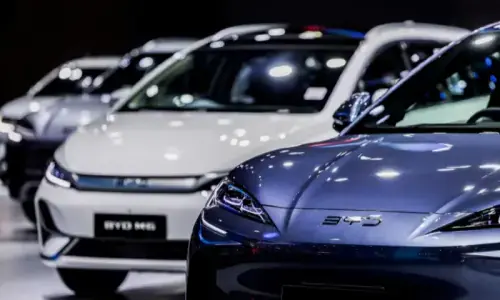
Master Group’s Chery Tiggo 7 PHEV (Rs9.5m) and the Nishat Group’s Jaecoo J7 (Rs10.499m) are two different brands of China’s Chery Group, targeting modern sport utility vehicle (SUV) customers in Pakistan who are going wild for electrified vehicles, with a focus on performance and technology.
In reality, both Chinese brands are built on closely related platforms, share core engineering, and deliver near-identical hybrid performance — yet are priced differently in the Pakistani market, with an almost Rs1m difference. A senior official at Chery Master said this is a new competition in the booming SUV market, not just between brands but also within the same global automotive groups.
The Tiggo 7 PHEV enters the C-segment as a plug-in hybrid built on Chery’s latest Super Hybrid architecture. It combines a 1.5TGDI engine with an 18.3 kWh battery and a dedicated hybrid transmission, producing strong power output and delivering up to 90km of pure electric range and a combined range of around 1,200km.
Tiggo 7 undercuts Jaecoo J7 sharply
The Jaecoo J7, meanwhile, is part of Chery’s newer sub-brand strategy aimed at a more design-led, lifestyle-oriented positioning. While it introduces a distinct exterior identity — more rugged, upright, and off-road inspired — its underlying engineering DNA remains closely aligned with Chery’s existing hybrid platforms.
The official said this is not unusual in the global auto industry. Shared platforms across different brands — often referred to as “badge engineering” — are common practice.
But in Pakistan’s price-sensitive market, such comparisons are increasingly influencing buying decisions.
For many buyers switching from conventional petrol to SUVs, this difference is not marginal — it materially impacts affordability and ownership economics, the official said.
As petrol prices remain high, PHEVs offer a practical middle ground — enabling daily commutes on electric power while retaining the flexibility of a combustion engine for longer journeys.
The official said buyers are no longer evaluating vehicles purely on exterior styling or badge perception, but increasingly on underlying engineering and cost efficiency.
As Pakistan’s hybrid segment expands, such intra-group comparisons are likely to become more common. Consumers are currently not upbeat about the look of vehicles, but they prefer vehicles that deliver more for what they pay, he added.
Published in Dawn, April 26th, 2026