US weighs Iran strike as second carrier en route
• Araghchi says draft nuclear plan to be ready in ‘next two, three days’
• Insists Washington has not asked for zero nuclear enrichment
• American bases, assets would be ‘legitimate targets’, warns Tehran’s envoy to UN
WASHINGTON: US President Donald Trump said he was considering a limited strike on Iran after ordering a major naval build-up in the Middle East aimed at pressuring Tehran to reach a deal to curb its nuclear programme.
The latest warning came after Iran’s foreign minister said a draft proposal for an agreement with Washington would be ready within days, following negotiations between the two sides in Geneva earlier this week.
Trump had suggested on Thursday that “bad things” would happen if Tehran did not strike a deal within 10 days, a deadline he later extended to 15 days.
Asked by a reporter on Friday whether he was contemplating a limited military strike, Trump replied: “The most I can say — I am considering it.”
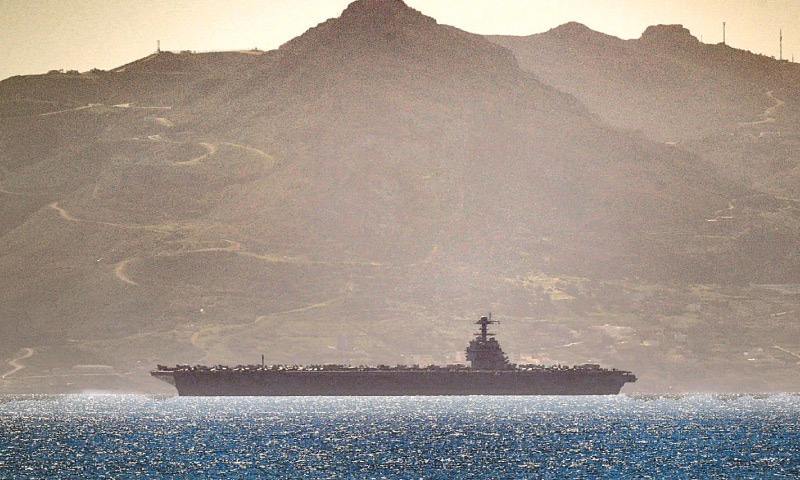
As part of the military build-up, the aircraft carrier USS Gerald R. Ford was seen entering the Mediterranean Sea on Friday, transiting the Strait of Gibraltar, after being ordered to the region by Trump. Washington had already deployed the USS Abraham Lincoln and escort warships to the Gulf in January.
After the talks in Geneva, Tehran said the two sides had agreed to submit drafts of a potential agreement, which Iranian Foreign Minister Abbas Araghchi told US media would be the “next step”.
“I believe that in the next two, three days, that would be ready, and after final confirmation by my superiors, that would be handed over to Steve Witkoff,” he said, referring to Trump’s main Middle East negotiator.
Araghchi also said US negotiators had not requested that Tehran end its nuclear enrichment programme, contradicting statements from American officials.
“We have not offered any suspension, and the US side has not asked for zero enrichment,” he said in an interview released Friday by US TV network MS NOW.
“What we are now talking about is how to make sure that Iran’s nuclear programme, including enrichment, is peaceful and would remain peaceful forever,” he added.
His comments stand in contrast to information relayed by high-ranking US officials, including Trump, who has repeatedly said Iran must not be allowed to enrich uranium at any level.
Western countries accuse Iran of seeking to acquire nuclear weapons, which Tehran denies, though it insists on its right to enrichment for civilian purposes.
Iran, for its part, is seeking to negotiate an end to sanctions that have proven to be a massive drag on its economy.
Economic hardships sparked protests in December that evolved into a nationwide anti-government movement last month, prompting a crackdown from authorities.
‘No ultimatum’
The two foes held an initial round of discussions on Feb 6 in Oman, the first since previous talks collapsed during the 12-day Iran-Israel war last June, which the US joined by striking Iranian nuclear facilities.
Washington has pursued a major military build-up in the region in tandem with the talks, and both sides have traded threats of military action for weeks.
On Thursday, Trump again suggested the US would attack Iran if it did not make a deal within the timeframe he laid out.
“We have to make a meaningful deal otherwise bad things happen,” Trump told the inaugural meeting of the “Board of Peace”, his initiative for the post-war Gaza Strip.
Iran’s ambassador to the UN, Amir Saeid Iravani, warned that US bases, facilities and assets would be “legitimate targets” if the United States followed through on its threats.
Araghchi, however, insisted that “there is no ultimatum”.
“We only talk with each other how we can have a fast deal. And a fast deal is something that both sides are interested about,” he said. “We are under sanctions, (so) obviously any day that sanctions are terminated sooner it would be better for us,” he said, adding Iran had “no reason to delay”.
Washington has repeatedly called for zero enrichment but has also sought to address Iran’s ballistic missile programme and its support for militant groups in the region — issues which Israel has pushed to include in the talks.
The Israeli army said on Friday that it was on “defensive alert” regarding the situation with Iran, but that its guidelines for the public remained unchanged.
Ratcheting up the pressure, Trump has deployed a significant naval force to the region.
Iranian naval forces also conducted military drills this week in the Gulf and around the strategic Strait of Hormuz in their own show of force.
The New York Times reported that the ambiguity around Trump’s aims could, according to some US officials and Middle East experts, be particularly dangerous, as it may lead Iran’s government to see an American-led offensive as an existential threat. As a result, Iran could escalate the conflict against the United States and Israel in ways it did not during the attacks last June, or after the US military assassinated Gen Qassim Suleimani, the head of Iran’s Islamic Revolutionary Guard Corps, in 2020.
Vali Nasr, an Iran expert at the Johns Hopkins School of Advanced International Studies, said there was a risk that Iran could calculate that its muted response to previous American military operations had only invited more threats from the United States, “and that it must escalate the cost of war for the US.”
Published in Dawn, February 21st, 2026