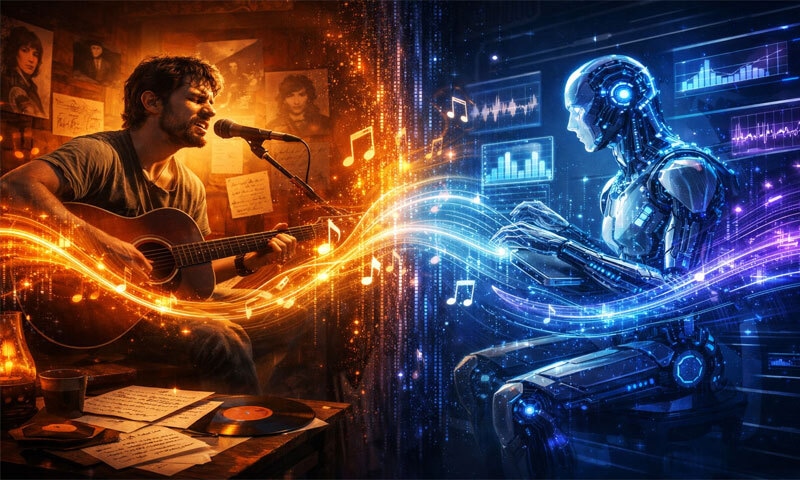

Think of your favourite song — something you’ve listened to a thousand times. It can be from any artist, genre or era: from Abida Parveen to Dua Lipa. Got one? Now imagine if I told you that the song you’ve loved all this time wasn’t actually written or performed by a human being at all.
Instead, what if it was entirely generated by artificial intelligence (AI)? Would it make a difference? Would it change how you feel about the song? Would you feel betrayed? Or would you simply shrug and keep listening?
With so much AI-generated music making its way into the world, the chances are you’re already bopping your head to tunes that were created partially — or even entirely — by algorithms. Powerful generative music platforms such as Suno and Udio have rapidly democratised music creation, dramatically lowering the barriers that once defined who could and couldn’t make music.
Knowledge of music theory, access to expensive studios, or years of technical training are no longer prerequisites. Thanks to AI, anyone with a phone, a prompt and a little spare time can create polished tracks and share them with the world.
If music sounds good, does it really matter who makes it — or how it is made? How do we come to terms with the flood of AI-generated music flooding our soundscapes?
This raises an uncomfortable but unavoidable question: if music sounds good, does it really matter who makes it — or how it is made? Personally, I think the answer depends entirely on who you’re asking.
COMPOSING, PERFORMING, RECORDING
Broadly speaking, music creation has three major components: composing, performing and recording. Let’s start with the last one — the recording process. The truth is, 99 percent of casual listeners don’t care how music is recorded. I’ll prove it to you. When was the last time you listened to a song and wondered whether it was recorded on analogue or digital hardware, or whether the reverberation was captured naturally or added during post-production? Exactly. Almost nobody does. These details matter to audiophiles, producers and engineers but, to the average listener, they’re irrelevant.
The same applies to performances. Most listeners don’t care whether instruments were recorded live or synthesised, whether parts were played by human hands or sequenced on a grid, or whether vocals were tuned, looped or layered. In fact, a significant portion of modern music already relies heavily on samples, MIDI instruments, and digital manipulation. Because of technological leaps over the last few decades, performance authenticity has quietly stopped being a deal-breaker. For most people, if it sounds real enough, it’s good enough.
Now, let’s talk about the composing process — and this is where things start to matter. Composition isn’t just the starting point of music; it’s also the most human part of the entire process. It’s where lived experience, emotion, culture and intention are transformed into melody and rhythm. This is the part listeners feel most deeply, even if they can’t always articulate why. And it’s also the part where AI poses the greatest philosophical and cultural challenge.
THE MEANING OF MUSIC
As we’ve already established, people rarely care if music is produced artificially. But they do care about who produced it and why. Music has always been a form of human expression — a way to communicate stories, emotions, and ideas that words alone often fail to capture. Through rhythm, harmony and melody, individuals and entire cultures express joy, grief, rebellion, hope, identity and shared experiences.
Legendary producer Rick Rubin put it best when he said, “What I find interesting about art is the point of view of the person making it — and I don’t know if AI has a point of view of its own.”
And that’s the crux of the issue. The greatest music ever made didn’t just sound good — it meant something. It emerged from specific people, living in specific moments, responding to the world around them. AI, by definition, has no lived experience. It doesn’t suffer, celebrate, struggle or dream. It can only analyse patterns and reproduce them convincingly.
That’s why AI-generated music, no matter how impressive, ultimately feels superficial. There are no stories behind its creations. No personal histories. No emotional stakes. No human context. At its very best, AI music is just a highly sophisticated imitation of what real artists have already done — but it can never be more than that.
This leads directly to the question of originality. Sure, AI can cleverly blend styles, genres and sonic textures to produce something that sounds ‘new’. But novelty is not the same as originality.
True originality isn’t about technical perfection or clever recombination — it’s about disruption. Originality is rejecting the polished mainstream and inventing an entire counter-culture like punk rock. Originality is transforming street culture, sampling and spoken word into hip-hop. Originality is killing glam rock excess and channelling the raw disillusionment of a generation into grunge. These movements didn’t come from optimisation or pattern recognition; they came from people responding emotionally, socially and politically to their environments.
AI can imitate our favourite artists, but it can never reshape culture the way they did. It can never preach like Bob Dylan, transcend like Nusrat Fateh Ali Khan, or hypnotise like Jimi Hendrix. More importantly, because AI models are designed to optimise what already works, much of AI-generated music will eventually begin to sound the same — over-polished, structurally familiar and emotionally safe. What you won’t hear are the rule-breakers, the trend-killers and the uncomfortable voices that push music forward the way it should be.
So does all of this mean AI music is inherently bad? Once again, it depends on who you ask.
TOOL VERSUS ARTISTRY
For many artists, the rise of AI-generated music is deeply concerning. Flooding the industry with fast, cheap and emotionless content risks devaluing years of craft, experimentation and lived experiences. As algorithms remix existing styles at scale, original voices can get buried under sheer volume.
There are also serious questions around ownership, consent and identity — especially when AI models are trained on the work of real musicians without clear permission or compensation. In that future, music risks becoming disposable background noise rather than a meaningful cultural artefact.
At the same time, it would be dishonest to ignore the positive potential. AI can be an extraordinary tool for creation and democratisation. It lowers barriers for people who lack formal training, financial resources or access to traditional music infrastructure. It allows experimentation without fear, invites play, and enables self-expression in ways that were previously impossible.
For many, AI won’t replace artistry — it will spark it. Used responsibly, it can become an instrument rather than a replacement, a collaborator rather than a competitor.
AI is not the death of music — but it is a mirror. It forces us to ask what we truly value in art. Is it technical perfection, convenience and endless output? Or is it perspective, vulnerability and human truth?
Music has always been more than sound. It is memory. It is a protest. It is a confession. It is a connection. AI can help us make music faster, cheaper and more efficiently — but it can never give music a soul. That responsibility still belongs to us.
The challenge ahead isn’t to reject AI outright, nor to embrace it blindly. It’s to use it thoughtfully — without losing sight of why music mattered long before algorithms learned how to make it. As long as humans continue to create from lived experiences, emotions and intentions, music will remain what it has always been: a deeply human act, played in many keys — but never without a heart.
The writer is Creative Director and Founder of Creative Liberty, a lead guitarist and songwriter. He can be reached at taimur@thecreativeliberty.com
Published in Dawn, ICON, February 8th, 2026