
I KNOW you’ve heard this before but the old is really, truly and comprehensively dead now and the new is literally being born before our eyes, with its little head, crowned in blood, passing the geopolitical cervix.
You can mourn the passing of the old and/or celebrate the coming of the new, but know that this is as natural a process as death and birth themselves; everything comes with an expiry date: be it people, nations, empires or international organisations.
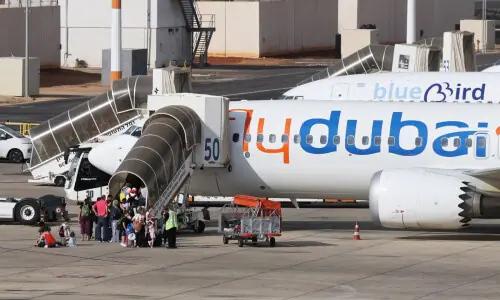
One of those organisations, the Organisation of Petroleum Exporting Companies, was dealt a body blow when its third largest oil-producing member, the UAE, acrimoniously exited the cartel, pledging to go its own way and pump oil unhampered by the Saudi-led OPEC’s quotas, which Abu Dhabi has long bristled at. The UAE has been building its oil production capacity for years now and certainly has made the calculation that they are better off going their own way and exporting all the oil they want before the inevitable global energy transition takes place. While this has been promoted by some quarters as a boon for a global economy choked by the closure of Strait of Hormuz and the US blockade, the fact is that there is no way for this excess oil to reach the global markets anytime soon; the Fujairah bypass is indeed working but that’s a drop in the global barrel at best.
Nor are the UAE’s only motivations financial or economic; the timing of the move, coming as it does during the war on Iran and in the backdrop of rising UAE-Saudi tensions, makes it clear that this is yet another manifestation of the UAE’s ‘never back down but rather double down’ approach to foreign policy. By exiting OPEC, to the approval of US President Donald Trump, the UAE has clearly signalled that it sees itself at the heart of a new Israel-centric regional order and has gone all in on the vision of a Middle East (and beyond) dominated by Israel, the US and the UAE, with India likely being the Asian pole of this alignment. Called the 12U2 partnership or the ‘West Asian Quad’, this aims to be the dominant force in a region increasingly looking for local alignments underpinned by one or more of the great powers.
Once useful organisations will be replaced by other systems.
In doing so, the UAE has also dealt a blow to the increasingly ineffective Gulf Cooperation Council, which now looks to be going the way of the OIC or even, dare I say it, Saarc, which could not survive Indian hostility to Pakistan. In much the same way the GCC will likely not survive the Saudi-UAE clash or the contradictions and divides the war on Iran has laid bare. After all, Oman — which is closest to Iran amongst all the Gulf states — was conspicuously absent in the latest GCC meeting. This is, of course, the natural course of things. The League of Nations collapsed under the weight of its own contradictions and ineffectiveness, to be replaced by the United Nations in which the winners of World War II were granted a special status (and veto powers) by being made permanent members of the Security Council. Now, that very organisation stands largely moribund and ineffective, no longer serving the needs of the times or adequately reflecting the changes that have taken place since the fall of Berlin in 1945. The same goes for other instruments of Western dominance like the International Criminal Court and the International Court of Justice, which dared to step beyond their unofficial mandate and take action against the genocidal state of Israel. After all, as US Senator Lindsay Graham reportedly said to the ICC’s chief prosecutor Karim Khan, “This court is built for Africa and for thugs like Putin, not for democracies like Israel and the United States.” This is not to say that these organisations will cease to exist — they will simply become increasingly irrelevant and ineffectual, ultimately ending up being a vestigial remnant of a once useful organ which will be replaced by other systems.
What would those systems look like? Those who imagine that BRICS will emerge as a bloc in its own right may be in for a disappointment given the deep divides within that very organisation. Take, for example, what happened in the last BRICS meeting when its incoming president India sabotaged the joint statement by trying to “tone down” language used against Israel to the opposition of just about every other BRICS member. Keeping these divisions in mind it would be unwise to place one’s trust in amorphous and frankly fuzzy terms like the ‘Global South’ as the alignments that are emerging will have less to do with largely arbitrary geographical dispensations, but will be based on the arguably more solid foundations of shared mutual interests and, perhaps more importantly, shared fears.
The writer is a journalist.
Published in Dawn, May 4th, 2026