Separatists to let Saudi-backed govt forces into held areas
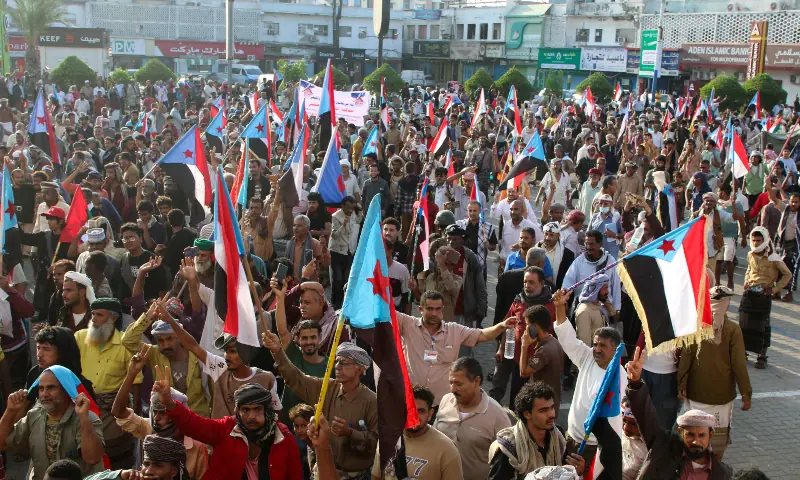
• STC says it will continue to operate in the seized regions
• Step unlikely to satisfy Riyadh, which has called for full withdrawal
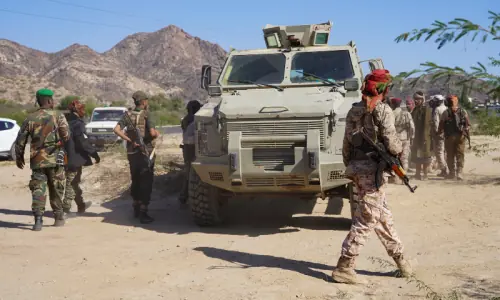
AL MUKALLA: Separatists from Yemen’s Southern Transitional Council said on Thursday that Saudi-aligned government forces would enter territories seized by the UAE-backed group, in a step that appeared unlikely to satisfy Riyadh after it repeatedly demanded their full withdrawal.
A surprise offensive by the STC, in which the separatists took control of resource-rich Hadramawt and Mahra provinces last month, has brought the United Arab Emirates and Saudi Arabia, officially allies in Yemen, to a point of unprecedented tension.
On Tuesday, the Saudi-led coalition in Yemen struck what it said was a shipment of Emirati weapons in the port of Mukalla destined for the separatists, a claim Abu Dhabi has denied, and demanded that STC forces withdraw from the newly captured territory.
In its statement on Thursday, the STC said it would continue to operate in the regions but had agreed to the deployment of the Riyadh-backed National Shield government force in the areas.
“Today, we launched an operation to integrate the southern National Shield forces so that they can assume the responsibilities and missions that fall to our armed forces,” they announced.
The statement said a National Shield brigade would be deployed in “areas of the Hadramawt and Mahra governorates, as agreed”.
But a source close to the Saudi government told AFP on Thursday that Saudi Arabia’s security needs would only be met if the STC “move out of Hadramawt and Mahra”.
The source, speaking on condition of anonymity, said the redeployment of government forces did not go far enough. “We have to wait and see what is carried out on the ground,” they added.
Another source close to the Saudi military said the Riyadh-led coalition was closely following events on the ground and making its own assessment.
The STC later dismissed criticism of the deal, saying that the government forces that would enter their areas would be predominantly made up of southerners who had been funded and supervised by Saudi Arabia.
“Their deployment along the Saudi border nullifies any argument used by those lying in wait to incite Saudi Arabia,” STC spokesman Anwar Al Tamimi told AFP.
Saudi Arabia, the main backer of the Yemeni government, had repeatedly urged the STC to withdraw from recently conquered territories, particularly areas along its southern border, and earlier conducted airstrikes against its positions.
Following the strikes on Tuesday, the UAE’s defence ministry said it would withdraw its last remaining troops in Yemen after Saudi Arabia imposed a 24-hour deadline for their removal.
The Yemeni government, of which the STC is a part, comprises a fractious coalition of groups united by their opposition to the Houthis who seized the capital Sanaa in 2014, and subsequently, large parts of northern Yemen.
The STC’s December advance raised the possibility of that South Yemen, a separate state from 1967 to 1990, might declare independence, while dealing a hammer blow to slow-moving peace negotiations with the Houthi rebels.
Emirati troops arrived in Yemen as part of the Saudi-led coalition fighting the Houthis, who had forced the government from the capital Sanaa in 2014 and seized much of the country.
Published in Dawn, January 2nd, 2026