IT is New Year’s Day, 2050. Pakistan’s 400 million people make it the world’s third most populous country. A four-decade-long youth bulge is as intense as ever, with half of the labour force between the ages of 15 and 29. Daily life is a rat race, punctuated by climate breakdown events and insurgencies. The state plays Leviathan under the guise of order.
As thought experiments go, projecting 24 years into the future on the basis of where we find ourselves today is no grand act of imagination. Only government propagandists and some mainstream commentators still argue that ‘Pakistan is turning a corner’. Most serious analyses acknowledge that the pace of economic, political, and social decay is hastening. Why engage in such gloomy scenarios? They compel us, I think, to imagine trajectories which are not only hopeful, but even revolutionary.
The idea of revolution has taken a beating since the end of the Cold War. US imperialism has backed a host of ‘coloured revolutions’ to roll back the legacies of the historic socialist revolutions and national liberation struggles of what Eric Hobsbawm called the short 20th century.
Here in Pakistan, where the left has been criminalised from the get-go, the meaning of revolution has been hollowed out further since the turn of the century by dictators like Musharraf and parachuted charlatans like Tahirul Qadri. Yet, a large number of digitally savvy youth consciously desire political transformation. The term ‘Gen Z revolt’ has gained great currency recently, following events in Bangladesh, Nepal, Madagascar, and Sri Lanka, where young people have exercised collective agency to overthrow incumbent regimes.
There is something heady about the fact that an otherwise amorphous, digitally connected cross-section of young people can crystallise into such a powerful force. But experience confirms that popular mobilisations can easily be co-opted, corrupted, or thwarted by the absence of a shared vision for substantive transformation.
The idea of revolution has taken a beating.
The recently scripted ‘Gen Z revolt’ in Mexico that reads like a Washington-backed ‘coloured revolution’ is only the most prominent example. Closer to home, Bangladesh’s ‘revolution’ has increasingly turned sour, perhaps unsurprisingly given the dubious politics of figureheads like Muhammad Younus.
How, then, do we make sense of this contradictory political landscape? Young political subjects are certainly willing and able to name structures of power, and even challenge them. But without romanticising the socialist revolutions and decolonisation movements of the past, what we miss today are organised mass parties with a clear ideological agenda. It is one thing to coalesce around the wrongs of the system on digital networks, but quite another to organise at the grassroots to put in place an alternative socioeconomic and political system.
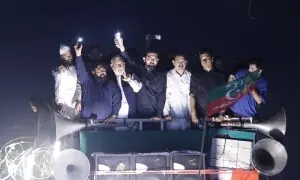
We may not see another era of mass parties, featuring trade unions and popular peasant organisations. Successful political entities that claim mass membership today largely rely on effective digital mobilisation strategies without necessarily sustaining parallel grassroots organisation. The PTI is the most obvious example. Indeed, it embodies many of the fundamental contradictions of the prototypical online Gen Z subject. Despite all that has happened since April 2022, is the ‘youth’ that catapulted the PTI to prominence 15 years ago now decisively opposed to Pakistan’s militarised and imperialised structure of power? Or is it still liable to co-option in intra-elite factional struggles?
Whatever the PTI’s future, there are still enough reasons to believe that Pakistan’s young working masses can come together to avert the dystopic scenario outlined at the outset. The crucial ideological pillars of a collective political project would read like this: 1) a developmental trajectory beyond capitalism featuring mass redistribution, job-creating industrialisation, and ecological regeneration; 2) an end to the brutalisation of ethnic peripheries and the crafting of a new, multinational identity; 3) ending the hegemony of the national security apparatus, decolonisation of Pakistani statecraft, and enshrining people’s needs as the object of state policy; 4) a commitment to redressing patriarchal violence — structural and physical — at all levels of state and society; 5) articulation of anti-imperialism and principles of non-alignment in foreign ties by discontinuing the state’s historical policies of auctioning the country’s geostrategic location, its natural resources, and labour for imperialist rents.
We are far from realising such an ideological agenda at present. But no matter how intellectually pessimistic we must be in the face of dark realities, we can retain a modicum of hope that such revolutionary horizons can still exist.
The writer teaches at Quaid-i-Azam University, Islamabad.
Published in Dawn, January 2nd, 2026