• 2025 a troubled year for the service, with repeated blasts, damage to bridges after March 11 hijacking • Security analyst says train’s mixed civilian profile gives attacks impact beyond Balochistan
• Railway officials claim seats booked up to Jan 10
BASHIR Ahmed lives in a two-room government quarter in Quetta. A father of five children who are currently on winter vacations, he is constantly being asked when they will travel to Peshawar.
Before the annual examinations, the children were planning to spend their winter vacations with their cousins in Peshawar. Mr Ahmed is also invited to the wedding of a close relative, scheduled in Peshawar for the first week of January.
“I wanted to take my family to Peshawar on the Jaffar Express… It is the only train available for travel to Punjab and Khyber Pakhtunkhwa, as all others have been discontinued,” Mr Ahmed tells Dawn.
But how can he think of putting his family aboard the train that comes under attack near the Bolan Pass on a weekly basis?
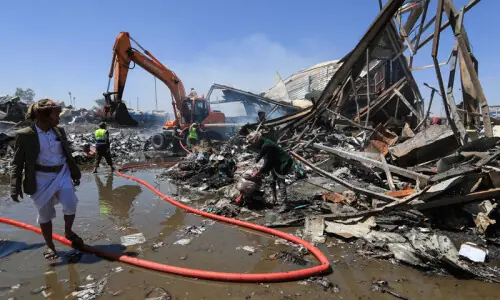
Rocket attacks, railway tracks and bridges being blown up, and attempted terrorist attacks on the train have become a commonplace occurrence now, with most people too scared to take the Jaffar Express.
This is not a new phenomenon: those old enough to remember would recall that attacks on railway tracks and gas pipelines have been a standard occurrence since the insurgency started in Balochistan in the year 2000.
However, passenger trains running between Quetta and the rest of the country have not faced such a volley of attacks since the 1970s, when the province experienced its first major insurgency, during the regime of then-PM Zulfikar Ali Bhutto.
The trigger was the first, and deadliest, attack of the year — the hijacking of the Peshawar-bound passenger train by Baloch separatist militants on March 11, 2025. At the time, the train was carrying around 500 passengers, including women, children and security personnel.
It was stopped and held hostage — along with its passengers — between the Hirk and Mushkaf areas, close to a tunnel. The hostage situation lasted for two days, resulting in several casualties among passengers and security personnel.
However, a subsequent operation by security forces prevented any further loss of life, with the train and the remaining passengers being successfully rescued.
Deadly alternative
“The hijacking of the Jaffar Express was the biggest and worst terrorist incident to have taken place in Balochistan during 2025,” a senior security official tells Dawn, adding that since then, the Jaffar Express had become a primary target for the separatist elements.
One might think that if the train is no longer a safe bet, one can always travel by road.
But there is a catch: passenger coaches that run between Quetta and every major city of Pakistan have also been in terrorists’ crosshairs, with several tragic incidents occurring over the past 18 months in which armed men allegedly intercepted coaches and, after checking identify papers, dragged out passengers who did not belong to Balochistan and executed them.
The situation worsened when bomb and suicide attacks and firing incidents started taking place on the national highways that link Balochistan with other provinces.
The takeover of highways by armed groups further created fear among the people, prompting the Balochistan government to impose a ban on night travel by coaches, buses and other forms of transport.
‘Business as usual’
But railway authorities have a different perspective on travel via the Jaffar Express. While acknowledging the frequent attacks on railway tracks and bridges, they insist that passenger numbers on the train are still quite encouraging.
“We have bookings for the Jaffar Express up to Jan 10,” Muhammad Kashif, the railway chief controller in Quetta, tells Dawn.
While that may be true, it is also a fact that during the past year, the line used by the Jaffar Express witnessed at least 10 incidents of track blasting, which sometimes led to the suspension of train services.
Similarly, at least one railway bridge was blown up, while four derailment incidents also took place at different areas along the route this year.
The train also faced sabotage twice, in the Shikarpur and Jacobabad areas of Sindh, while in a separate incident, five bogies were derailed and some passengers were injured in Jacobabad.
‘Symbolic, strategic importance’
Security experts believe that the Jaffar Express is targeted due to its strategic role: security personnel, including army troops, use it to travel to Punjab and Khyber Pakhtunkhwa. People living in Balochistan also use the Jaffar Express for their travel.
Muhammad Amir Rana, a security analyst and director of the Pakistan Institute for Peace Studies (PIPS) in Islamabad, is of the opinion that the train passes through a critical railway route, which connects Balochistan with the rest of the country.
It is widely used by Baloch students studying in Punjab, Punjab-based families and lower-ranking public sector employees, including personnel from various security services. This civilian-heavy passenger profile gives the route both symbolic and strategic importance, making it a prime target for insurgent groups.
“An attack on the Jaffar Express carries repercussions far beyond Balochistan. Its impact is felt strongly in Punjab, which is precisely what insurgents seek: to widen the psychological and political footprint of violence and draw national attention,” Mr Rana said, explaining why the train remains a preferred target for miscreants.
Best-laid plans
For Bashir Ahmed — the father of five — all of these are risks he can’t afford. “I cannot take the risk of traveling with my family on the Jaffar Express or by coach, nor can I afford to travel by air, as all airlines, even PIA, have increased the prices of air tickets.” Even ministers and MPAs have taken this issue to the assembly, saying they cannot purchase such exorbitantly priced air tickets.
“How can a government employee travel with his family by air?” Mr Ahmed asks, before revealing that he has cancelled his plans to visit Peshawar and will spend winter vacations in Quetta instead.
Detailed version can be accessed at Dawn.com
Published in Dawn, December 31st, 2025