0
0

• Claims Tehran has not ‘paid a big enough price’
• Iran says received US response to its latest offer for talks
• IRGC insists US faces choice between an ‘impossible operation’ or a ‘bad deal’
• German FM calls Araghchi, demands Hormuz reopening
• Jordan praises Pakistan’s constructive role for peace, regional stability
WASHINGTON: US President Donald Trump said that he had yet to review the exact wording of a new Iranian peace proposal but he was unlikely to accept it, because the Iranians had not yet “paid a big enough price”.
Mr Trump’s remarks on social media concluded a day in which he publicly mused about the possibility of restarting air strikes, the latest mixed signal as he seeks to end the war he launched more than two months ago.
Iran’s Tasnim and Fars news agencies reported that Tehran had submitted a 14-point proposal to mediator Pakistan, but Trump was quick to cast doubt on it.
“I will soon be reviewing the plan that Iran has just sent to us, but can’t imagine that it would be acceptable in that they have not yet paid a big enough price for what they have done to Humanity, and the World, over the last 47 years,” Mr Trump said on his Truth Social platform.
US news website Axios reported, citing two sources briefed on the proposal, that it set “a one-month deadline for negotiations on a deal to reopen the Strait of Hormuz, end the US naval blockade and permanently end the war in Iran and in Lebanon”.
Iran later said on Sunday it had received a US response to its latest offer for peace talks.
The state media reported that Washington had conveyed its response to Iran’s 14-point proposal via Pakistan, and that Tehran was now reviewing it. There was no immediate confirmation from Washington or Islamabad of the US response.
“At this stage, we do not have nuclear negotiations,” state media quoted Iran’s Foreign Ministry spokesperson Esmaeil Baghaei as saying.
Meanwhile, Iran’s Revolutionary Guards said the US faced a choice between an “impossible” military action or a “bad deal” with Tehran. “The room for US decision-making has narrowed,” they said. On Saturday, a senior Iranian official had also confirmed that Iran’s proposal would first open shipping in the Strait of Hormuz and end a US blockade of Iran, while leaving talks on Iran’s nuclear programme for later.
US Treasury Secretary Scott Bessent has claimed that the United States is “suffocating” Iran’s leadership through an “economic blockade” launched alongside the US military offensive.
“We are suffocating the regime, and they are not able to pay their soldiers. This is a real economic blockade, and it is in all parts of government — all hands on deck,” he said in a Fox News interview.
The United States and Israel suspended their bombing campaign against Iran four weeks ago but appear no closer to a deal to end a war that has caused the biggest disruption ever to global energy supplies, roiled global markets and raised worries about the possibility of a wider global economic downturn.
Though Trump had already said on Friday that he was not satisfied with the Iranian proposal, he said on Saturday he had yet to hear all the details. “They told me about the concept of the deal. They’re going to give me the exact wording now,” he said.
Asked if he might restart strikes on Iran, Mr Trump replied: “I don’t want to say that. I mean, I can’t tell that to a reporter. If they misbehave, if they do something bad, right now we’ll see. But it’s a possibility that could happen.”
The day before, Deputy Foreign Minister Kazem Gharibabadi told diplomats in Tehran that “the ball is in the United States’ court to choose the path of diplomacy or the continuation of a confrontational approach”. Iran, he said, was “prepared for both paths”.
In yet more bellicose rhetoric, Mohsen Rezaei, a military adviser to Iran’s Supreme Leader Mojtaba Khamenei, said Iranian forces would sink US ships.
“The US is the only pirate in the world that possesses aircraft carriers. Our ability to confront pirates is no less than our ability to sink warships. Prepare to face a graveyard of your carriers and forces,” he posted on X.
The deputy speaker of Iran’s parliament, Ali Nikzad, said that under draft legislation being considered for managing the strait, 30 per cent of tolls collected would go towards military infrastructure, with the rest earmarked for “economic development”.
“Managing the Strait of Hormuz is more important than acquiring nuclear weapons,” he said.
Germany demands Hormuz reopening
German Foreign Minister Johann Wadephul on Sunday demanded that Iran reopen the Strait of Hormuz and give up its nuclear weapons programme in a telephone call with Iranian counterpart Abbas Araghchi.
“I emphasised that Germany supports a negotiated solution,” Mr Wadephul said in a post on X about the call.
“As a close US ally, we share the same goal: Iran must completely and verifiably renounce nuclear weapons and immediately open the Strait of Hormuz, as also demanded” by US Secretary of State Marco Rubio, Mr Wadephul said.
In recent days, Mr Wadephul and other German officials have been trying to ease a spat between US President Donald Trump and German Chancellor Friedrich Merz.
Mr Merz said on April 27 that Iran was “humiliating” the United States at the negotiating table, which provoked a series of angry responses from Washington.
Dar meets Jordanian counterpart
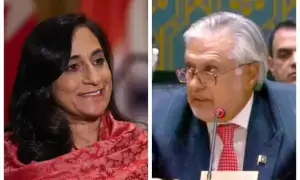
Deputy Prime Minister and Foreign Minister Ishaq Dar spoke on Sunday with his Jordanian counterpart, Ayman Safadi.
Mr Safadi conveyed Jordan’s appreciation of Pakistan’s constructive role and continued efforts for peace, dialogue and regional stability in the context of ongoing tensions in the region.
Mr Dar reaffirmed Pakistan’s commitment to promoting constructive engagement among all parties to support stability and the peaceful resolution of conflicts through dialogue and diplomacy.
The two leaders also reaffirmed the strong bilateral relations between Pakistan and Jordan, and underscored the importance of continued cooperation at bilateral and multilateral forums. They agreed to remain in close contact.
Published in Dawn, May 4th, 2026