Oil industry rejects digital integration sans compensation


 0
0
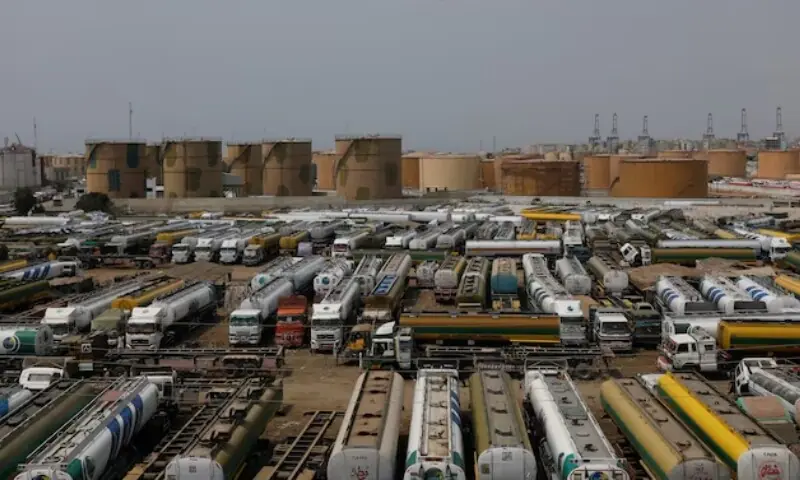

ISLAMABAD: The country’s oil industry on Tuesday rejected the unilateral imposition of a 6-12 month regulatory deadline for complete digital integration of more than 32,000 ground tanks, oil depots and petrol pumps across the country without any mechanism for Rs55 billion cost recovery.
In a formal letter to the Oil & Gas Regulatory Authority (Ogra) and the Petroleum Division, the Oil Companies’ Advisory Council (OCAC) — an association of more than three dozen oil companies and refineries — has pointed out technical and financial challenges and protested over ‘dictatorial’ instructions which could not be implemented as quickly. The Oil Marketing Association of Pakistan (OMAP), another industry association of smaller companies, also protested.
An industry executive told Dawn that an Ogra team led by Chairman Masroor Khan called a meeting with chief executive officers of the Oil Marketing Companies (OMCs) to be ready to face punitive action if they failed to digitally integrate 600 installations by Jan 31, 2026 and the remaining by Jan 31, 2027. There are a total of about 32,000 storage facilities, including ground tanks, oil tankers and retail pumps. All 16,000 pumps have to be digitally integrated by June 2026. Under the Auto Tank Gauging (ATG) system, all have to be linked to a central dashboard for complete visibility of every litre of petrol.
“We were not allowed to speak and share ground realities. The Ogra chairman tersely announced that the digital integration of the oil supply chain is the vision of the prime minister, and you have to comply with the given deadlines (Jan 31, 2026, and 2027). All I have to convey is that those failing will face punitive action”, an executive quoted the Ogra chairman as saying.
Stakeholders question practicality of Ogra’s push for digital tracking of 16,000 pumps by June
Meanwhile, a combined delegation of OCAC and Oil Marketing Association of Pakistan (OMAP) held an emergency meeting with Petroleum Minister Ali Pervaiz Malik to register their position. The minister asked the regulator to look into “addressing the areas highlighted by the industry” to jointly transform the petroleum sector for the benefit of consumers, businesses, and the national economy, an official statement said.
Industry representatives said the industry was fully supportive of the digital integration initiative, but the supporting infrastructure was not available off-the-shelf and required hardware design and production involving Rs55-60bn across the industry. “We are already making hefty payments to Ogra and Pakistan Information Technology Board (PITB) for regulatory compliance and track & trace system, no more”, he said.
Soon after the Ogra meeting, the oil industry went into a separate session and decided that the threatening stance was unacceptable. “Industry on its own would not foot such a big bill. Do they want us to go bankrupt?” asked a flabbergasted industry executive.
The OCAC soon issued a letter to the regulator to launch a formal protest. “At the outset, we would like to express our concern that the meeting proceeded largely as a monologue by OGRA. Despite multiple attempts by OCAC to present the industry’s position, our repeated requests to speak were disregarded,” said the OCAC in writing through its chairman Adil Khattak.
The OCAC said it had repeatedly requested a phased implementation timeline for retail outlet digitisation and ATG installation, supported by a viable cost recovery mechanism to be finalised by Ogra. Given the scale of the task and the total number of retail outlets nationwide, the industry required a realistic implementation window of at least five years to execute this transition effectively because ATG system was a capital-intensive, high-complexity initiative. “Each ATG unit is custom-built according to specific tank configurations and requires substantial lead time for procurement, installation, integration, and calibration.”
On top of that, the industry said the challenge was further compounded by the fact that OMC margins have remained stagnant for the past two years, severely limiting the industry’s capacity to absorb additional financial burdens. It highlighted that the industry already paid millions of rupees toward the Track and Trace System (Phase II) under the leadership of PITB. “Yet, there remains no update, no completion timeline, and no demonstrable outcome from this expensive exercise.”
Published in Dawn, December 4th, 2025