PSX settles above 166,000 in November
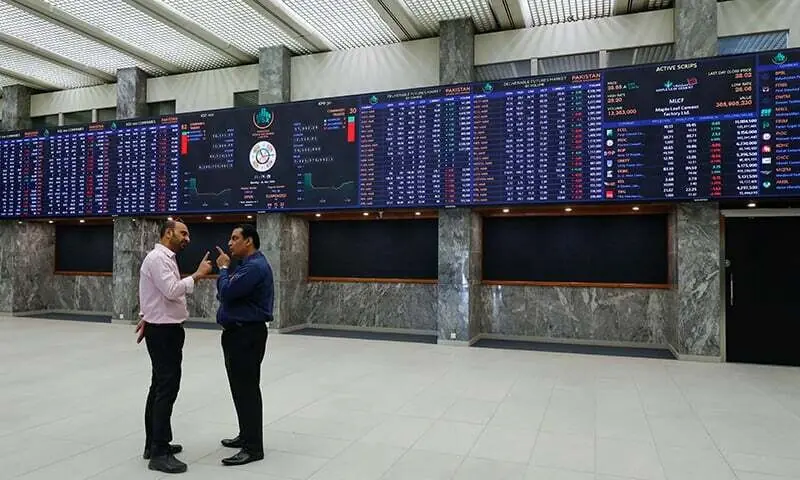


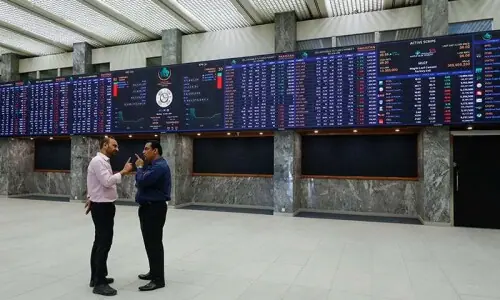
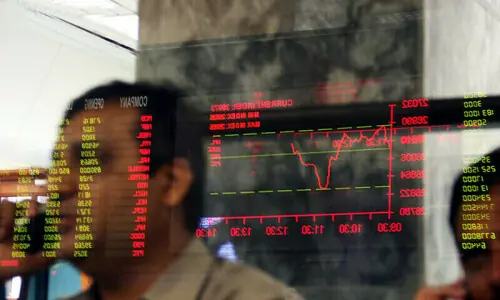
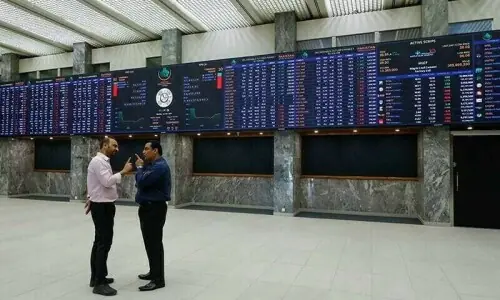
KARACHI: The Pakistan Stock Exchange (PSX) closed the outgoing week and month on a firm footing as the benchmark KSE-100 index sailed past the 166,000 barrier in the final session of the rollover week, buoyed by renewed institutional buying and improving macro indicators.
After beginning the week under pressure amid profit-taking, investors returned to value positions across key sectors, helping the benchmark claw back losses and resume its upward trajectory.
Topline Securities reported a 3.12 per cent month-on-month gain for the index in November, crediting the rise to stronger participation from local institutions and retail investors. However, overall activity thinned, with average daily volume sliding 42pc to 819 million shares and traded value dropping 34pc to Rs34.8 billion.
Key economic indicators shaped the month’s sentiment. October’s inflation edged up to 6.2pc year-on-year from 5.6pc in September. Workers’ remittances climbed to $3.42bn, up 12pc year-on-year and 7pc month-on-month. The current account swung to a $112m deficit after posting an $83m surplus in September.
Foreign direct investment clocked in at $179m, rising 23pc year-on-year but slipping 4pc month-on-month. The real effective exchange rate increased to 103.95, while Large-Scale Manufacturing grew 2pc month-on-month and 2.7pc year-on-year in October.
Economic data, IMF board meeting and Reko Diq project’s financial close lift investor sentiment
Arif Habib Ltd (AHL) said the index gained 4,575 points, or 2.82pc week-on-week, to close at 166,677.70. Fertiliser stocks strengthened as Fauji Fertiliser Company (FFC) surged ahead of its inclusion in the KMI-30 index.
Pakistan Petroleum Ltd (PPL) rallied on optimism over Reko Diq’s nearing financial close, while Oil and Gas Development Company (OGDC) gained after receiving its fifth interest payment of Rs7.725bn.
Investor confidence was also buoyed by the upcoming IMF Executive Board meeting on Dec 8, during which Pakistan expects approval of a $1.2bn tranche under the Extended Fund Facility and the Resilience Sustainability Fund.
AHL noted that approval would take total disbursements to about $3.3bn, reinforcing external stability. In the latest T-bill auction, the State Bank of Pakistan accepted Rs749bn against a target of Rs650bn. The one-month paper cut-off yield stood at 10.89pc, while the three- and six-month tenors stayed at 11pc. The 12-month paper attracted the highest interest, with yields at 11.27pc.
Broad money (M2) reached Rs39.98 trillion as of Nov 14, up 12.15pc year-on-year, while private-sector credit contracted 0.68pc. Bank deposits rose nearly 10pc.
The SBP-held foreign exchange reserves rose by a meagre $9.2m to $14.560bn during the week ending Nov 21. However, the country’s total liquid foreign reserves decreased to $19.605bn from the previous week’s $19.738bn due to a decline in commercial banks’ foreign exchange holdings, which fell from $5.186bn to $5.044bn in the latest week.
The current forex holdings are sufficient to cover 2.36 months of imports. The rupee appreciated marginally by 0.04pc week-on-week to close at 280.52 against the dollar.
Analysts at AHL expect the market to retain its positive tone next week, supported by anticipated IMF approval and improved reserve prospects. The index trades at a price-to-earnings ratio of 8.42x, slightly below its 15-year average of 8.59x, offering a dividend yield of around 5.8pc.
IMF optimism fuels bull run
AKD Securities echoed the upbeat outlook, attributing the week’s momentum to optimism surrounding the IMF board meeting. Petroleum Minister Ali Pervaiz Malik’s statement that Reko Diq was closing in on financial close — with $3.5bn in loans secured — triggered a strong rally in exploration stocks, contributing 843 points to the index. FFC’s inclusion in the Shariah-compliant index added another 1,582 points.
Despite the rally, market participation slipped 14.2pc week-on-week, with average daily volume falling to 1.1bn shares.
Other developments included the Special Investment Facilitation Council’s new investment roadmap, Prime Minister Shehbaz Sharif’s target of $1bn in trade with Bahrain over three years, Chinese plans for a $1.5bn industrial park, and business deals worth $615m at Food Exhibition 2025. The IMF also acknowledged improvements at the Competition Commission of Pakistan.
Winners and laggards
Top-performing sectors included leather and tanneries (12.9pc), fertiliser (4.9pc), commercial banks (2.9pc), technology and communication (2.8pc) and cement (2.6pc). Jute, modarabas, refineries, leasing companies and glass and ceramics were among the worst performers.
Banks and DFIs were net buyers of $14.5m, followed by mutual funds, which were net buyers of $9.5m. Foreign investors and individuals offloaded $12.9m and $9.1m, respectively.
Sui Southern Gas Company led individual gainers, rising 18.2pc. It was followed by Services Industries (14.2pc), Pioneer Cement (10.1pc), Hum Network (9.1pc) and Fatima Fertiliser (8.1pc).
Major laggards included Packages Ltd (down 6.7pc), Bestway Cement (5.8pc), Yousuf Weaving (4.4pc), Cnergyico PK (4.3pc) and Attock Refinery (4.1pc).
Published in Dawn, November 30th, 2025