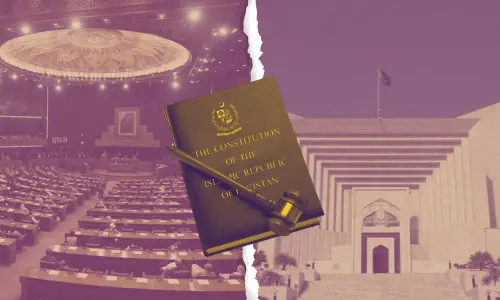
In a statement issued on Sunday after its 39th annual general meeting, the Human Rights Commission of Pakistan (HRCP) expressed concern over the 27th Constitutional Amendment, noting that lifetime immunity for public 0ffice holders had “concentrated unchecked power in the hands of a few”.
The contentious tweak was passed by Parliament on November 13 after days of heated debate, opposition protests, and last-minute revisions, and received the president’s assent the same day.
The amendment made significant changes to the judicial system and the military’s chain of command, and granted sweeping immunities to government officials. Under the Amendment, lifetime immunity from arrest and all criminal and civil proceedings has been granted to the president and anyone holding the ranks of Field Marshal, Admiral of the Fleet and Marshal of the Air Force.
Referring to the Amendment, the HRCP drew attention to “escalating threats to constitutional democracy, civic freedoms, and the safety of vulnerable communities across the country”.
The HRCP said it “is deeply concerned over the passage of the 27th Constitutional Amendment, which undermines judicial independence by expanding executive control over matters that should remain free from executive interference”.
“The amendment further weakens essential checks and balances at a time when public trust in state institutions is fragile. Lifetime immunity for holders of public office has concentrated unchecked power in the hands of a few, eroding parliamentary supremacy,” the commission’s statement read.
The human rights body also stressed that empowered and elected local governments were critical for deepening democracy and strengthening citizens’ participation in governance.
It underlined that efforts to curb militancy in Khyber Pakhtunkhwa and Balochistan “must protect fundamental freedoms and the right to dissent”.
“Blanket internet shutdowns in Balochistan and other parts of the country have disrupted education, livelihoods, and democratic participation and must end immediately.
“[The] HRCP urges the federal and provincial governments to implement rights-respecting security measures, conduct impartial investigations into abuses by state actors, and engage meaningfully with local communities. This includes ending enforced disappearances and the use of interment centres without due process.”
“The use of the Fourth Schedule to muzzle dissent must cease,” the statement said.
The Fourth Schedule of the Anti-Terrorism Act 1997 (ATA) is a list of individuals placed under observation by the government on suspicion of their involvement in terrorism or sectarianism.
The statement added that the HRCP “notes with alarm the ongoing harassment, detention, and forced repatriation of Afghan refugees, many facing credible threats of persecution, family separation, and severe humanitarian distress”.
“The government must suspend deportations, ensure due process, and uphold international protection standards. Pakistan should ratify the 1951 UN Refugee Convention and 1967 Protocol and protect the right to citizenship by birth and naturalisation,” the HRCP emphasised.
It further stated that custodial torture and extrajudicial killings, “particularly involving Crime Control Department and Counter-Terrorism Department personnel”, demanded urgent independent inquiries and accountability.
“Such violations perpetuate impunity and threaten citizens’ right to life and dignity.”
Moreover, the HRCP noted that religious minorities, especially Ahmadis, continued to face mob violence, attacks on their sites or worship and desecration of graves.
The state must ensure protection, prosecute incitement, and implement the delayed commission to investigate misuse of the blasphemy law, as well as legislate against forced conversions, the HRCP statement added.
It further said that child marriage remained pervasive in the country, endangering girls’ health, education, and futures.
“[The] HRCP calls for legislative reforms to define a minor consistently across laws and declare all marriages under 18 illegal.
“Sexual harassment in educational, public and private institutions also persists; robust reporting, transparent accountability, and preventive training are essential to safeguard learning environments and workplaces.”
The HRCP also urged the government to protect climate-displaced persons, especially in Gilgit-Baltistan, with safe shelter, essential services and sustainable resettlement solutions.
The authorities must also ensure long-term support for rebuilding homes and livelihoods for those affected by the recent floods, particularly in South Punjab, the HRCP said.
Lastly, the human rights body stressed that incarcerated Indian and Pakistani fisherfolk must be repatriated to their respective countries and receive humane treatment, legal representation and protection from arbitrary detention to preserve their rights and livelihoods.