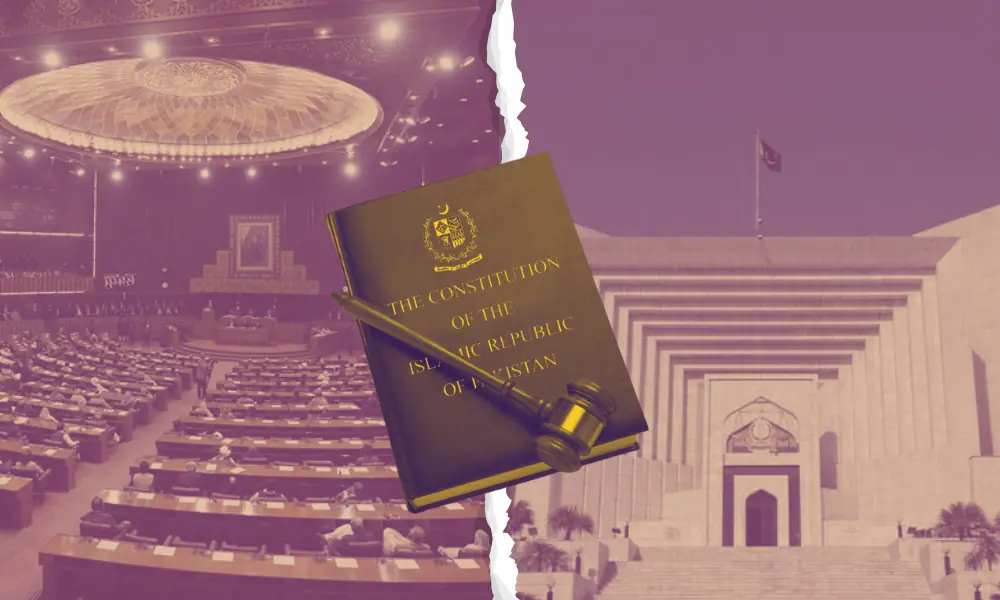
27th Amendment: The end of an era
After five days of heated debate, opposition protests, and last-minute revisions, the 27th Constitutional Amendment Bill was passed by Parliament on Thursday. A swift and subsequent signature by the head of state, and it is now a reality.
With this, the separation of powers and basic structure established by the 1973 Constitution of Pakistan — which envisioned an independent judiciary and armed forces subservient to the civilian dispensation — now stands terminated. The irony isn’t lost here that instead of the military, an independent judiciary has been amended away into a subservient department of the executive branch.
Two senior judges of the Supreme Court of Pakistan, both former chief justices of their respective provincial high courts, and one who should have been the incumbent Chief Justice of Pakistan, have tendered their resignations on grounds of complete judicial capture and constitutional distortion in the wake of the 27th Amendment. More resignations from independent judges are expected.
All of this has been achieved by a parliament that is widely perceived to be unrepresentative of the polity.
Much has been written and said in the past few days condemning the 27th Amendment and calling it the darkest chapter in Pakistan’s constitutional and legal history. Funeral rites referenced and obituaries have been written for the Supreme Court, in some cases by those who actively abetted this murder. At the same time, the military leadership has been able to secure constitutional and legal cover for itself that previous dictators and hybrid regimes, of which Pakistan has had many, have only dreamt of.
What is the 27th Amendment?
The amendment makes significant changes to the judicial system, the military’s chain of command and grants sweeping immunities to government officials.
A Federal Constitutional Court (FCC) has been established as the apex court in Pakistan, while the Supreme Court has been reduced to a final appellate court for civil and criminal matters. All matters of a constitutional nature, including those involving disputes between provincial and federal governments, public interest and the enforcement of fundamental rights of the people, will be heard by the FCC.
The chief justice and all judges of the first FCC will be handpicked by the prime minister and the President and shall remain in office till the age of 68. There is no stated criterion for the selection of these judges. The FCC will not be bound by any earlier decision in the decades-long jurisprudence of the Supreme Court, but the Supreme Court and all other courts will be bound by the decisions of the FCC.
In the future, a Special Parliamentary Committee will select the chief justices of the Supreme Court and the FCC from amongst the judges of the respective courts. There is no stated criterion for a judge being selected to either position. Previously, the senior-most judge of the Supreme Court was automatically selected as the chief justice of Pakistan without any selection by the government.
The Judicial Commission of Pakistan (JCP), which selects judges for elevation to the Supreme Court, the FCC and the high courts by voting, will be dominated by political, executive-branch members. Only five out of 13 members of the JCP will be judicial appointments (two executive-appointed FCC judges and two senior-most judges of the SC, and one more judge of either court).
Before the 26th Amendment, the judges of the superior courts were selected by a JCP which had a majority of judicial members; this means that the judiciary was selecting judges from within itself without being outvoted by the executive’s representatives on the JCP.
The executive-dominated JCP will also have the power to recommend the transfer of judges from one high court to another through the President. If a judge does not accept the transfer, they will undergo disciplinary proceedings (which are not public) before the Supreme Judicial Council (consisting of executive-appointed judges) and may be removed for misconduct. There is no stated criterion on the basis of which judges may be transferred from one court to another, and therefore no way of assessing whether there are any legitimate grounds for transfer.
Amendments have also been made to grant lifetime immunity from arrest, and all criminal and civil proceedings to the President and anyone holding the ranks of Field Marshal, Admiral of the Fleet, and Marshal of the Air Force. The position of the Chairman of the Joint Chiefs of Staff Committee has been abolished. The National Strategic Command has been transferred to the military. The army chief will be the Chief of Defence Forces, making him the head of all military services, including the army, navy and air force. The Field Marshal has been empowered to retain his rank, privileges and uniform for life.
And finally, there is another person-specific amendment which allows Justice Yahya Afridi to retain his title of the CJP. After him, the title may no longer reside at the Supreme Court.
Did the judiciary need this overhaul?
According to the regime, its unelected parliamentarians and pro-regime opinion makers, these amendments are necessary to control a superior judiciary that had become all-powerful and was stepping outside its constitutional role.
Some judges, they say, are too “independent”, guilty of judicial overreach, and that is not desirable. The Saqib Nisar, Khosa and Bandial terms are particularly lamented.
Let’s divide “judicial overreach” into two categories. The first category is where courts have interfered in politics or persecuted politicians, and the second category is where courts have made populist decisions that interfered with policy.
When courts have interfered with politics, endorsed martial laws or removed prime ministers, it was not because they were “independently” exercising their own preferences. It was because they were too susceptible to pressure from certain quarters that used them as tools for political engineering. Decisions in Maulvi Tamizuddin, Dosso, Nusrat Bhutto, and Zulfiqar Ali Bhutto are a testament to the courts being used to achieve state objectives and not judicial preferences.
More recently, the judges of the Islamabad High Court, in a display of historic courage and national spirit, through their letter to the then-CJP Qazi Faez Isa and more recently through petitions before the Supreme Court, have documented the kind of coercion and pressure judges in this country are subject to when they act “independently”.
Mere days ago, Justice Athar Minallah, in a letter to Chief Justice Afridi, detailed the pressure judges were under before passing an “undesirable” judgment in favour of the PTI in the reserved seats matter.
Does this demonstrate a judiciary so “independent” that it must be brought under executive control? Absolutely not.
In cases where the courts have acted out of socio-economic populism and interfered with policy or the Supreme Court exercised its original jurisdiction under Article 184(3), the record is mixed. While there have been dam debacles, there has also been progress for missing persons/enforced disappearances, women’s rights and environmental actions.
There is no denying that there have been judicial excesses at times, but the courts have also advanced fundamental rights and kept creeping authoritarianism and state overreach in check. It’s possible to acknowledge a mixed record without dismantling the entire institution.
As with any evolving institution in a nascent, post-colonial democracy prone to military takeovers, the judiciary has been imperfect, sometimes excessive and at others more accommodating of certain interests. If the problem is that the judiciary has been too easily influenced or captured in the past, the solution cannot be to strip it entirely of independence and render it beholden to the executive.
Especially when the executive is as prone to elite/ military capture as it is in Pakistan; this will only intensify the use of courts as a tool for political engineering and punishing opponents, with no recourse or hope of a dissenting opinion.
A more basic and easily debunked argument is that these changes to judicial structure will solve the problem of case pendency and litigation delays. This is a catchy lie. Cases at the Supreme Court account for less than three per cent of pending cases nationwide. The remaining case pendency is before the district and high courts, where endemic issues of understaffing, underfunding, poor case management, corruption and bribery, and a culture of litigation continue unabated.
Parliamentary supremacy or constitutional democracy?
The regime and its friends will tell you that Parliament is supreme and can amend the Constitution as it wishes. They will also tell you that such amendments cannot be questioned by any court because of Parliament’s absolute power to amend laws under Article 239 of the Constitution.
There are several responses to this claim of parliamentary supremacy. The first and most intellectually honest response is that constitutional democracies and legal traditions across the world disagree about the origin and distribution of power within a constitutional separation of powers arrangement.
Common law systems such as the USA and India have stood by constitutional supremacy. The courts have extensive powers of judicial review, and in India and other countries, the basic structure doctrine is recognised, which means that the basic features of the constitution, such as separation of powers, democracy, and independence of the judiciary, cannot be amended away by parliament.
This indicates that the legislature cannot amend the basic social contract into anything it desires simply because it has the procedural ability to do so. The doctrine is also recognised by the Supreme Court in District Bar Association Rawalpindi vs Federation of Pakistan (PLD 2015 SC 401).
Separately, as argued by Justice Isa in his Rawalpindi Bar judgment, the 1973 Constitution did not envision parliamentary sovereignty which prevented courts from reviewing amendments. Article 239’s bar on judicial review of amendments was introduced in the 8th Amendment so a dictator, General Zia-ul-Haq, could maximise his own power. Therefore, these provisions are inherently undemocratic and illegitimate.
There is also the preamble to the 1973 Constitution, which seeks to establish representative democracy, federalism and an independent judiciary. If all of these features may be amended away, then what is the nature of the constitutional document?
We should consider whether a strong, independent judiciary as a watchdog of salient constitutional features is more likely to serve our democracy and protect fundamental rights, or an entirely unchecked parliament with unlimited legislative powers.
While reasonable (and honest) people may disagree about the origins of constituent and amendment powers and constitutional versus legislative supremacy, one thing should not be lost in the noise of seemingly innocent democratic arguments: even if parliament is supreme, an unrepresentative parliament, acting in the interest of a select few, does not have the legitimacy to amend the Constitution of Pakistan into oblivion.
Legitimate constitutional amendments are the product of democratic consensus, public debate and transparent collaboration over months and years, not the work of invisible forces rushed through in hours and days.
The road to the present
Other worrying explanations for how we have ended up here include a lack of resistance and truth-telling over the past several years, all the way up to the passage of the Supreme Court (Practice and Procedure) Act, 2023, and the 26th Amendment.
Dissonant positions born out of severe political partisanship and a deep-rooted national cynicism about “how things are” in Pakistan haven’t helped. Fear of a PTI populist wave and distrust of its leadership caused many ‘progressives’ to cheerlead and justify one encroachment on civilian supremacy after another.
Deep divisions within the senior judiciary following the reference against Justice Isa resulted in the inability to put aside personal agendas and opportunism to protect the institution. External actors didn’t have to try very hard when, at every juncture, judges stood ready to become collaborators, undermining each other and the court in pursuit of personal gain or animosity.
Why should the average Pakistani care?
The 26th and 27th Amendments to the Constitution are the latest assault on fundamental rights and democratic freedoms in Pakistan. But they are part of the same coercive project that seeks to crush the will of the people, keep their elected representatives out of office, and entrench an unelected elite at the top.
No ordinary Pakistani, irrespective of political affiliation or ideological gymnastics, will remain unaffected or benefit from the collapse of the judiciary and the empowerment of military elites. This will not stop here.
We already know the damage an executive-controlled court can do, not just in our history, but in the conduct and decisions of the Supreme Court’s Constitutional Bench following the 26th Amendment. It reversed the SC’s reserved seats decision and gave an unrepresentative majority to an unelected government by denying reality. It allowed the secret court martials of ordinary civilians. It allowed the transfer of judges as an instrument of control. It argued in riddles and tautologies to justify the 26th Amendment.
In exchange, Justice Aminuddin, who led this bench, has been rewarded with the chief justiceship of the new FCC. As this piece is being written, he takes the oath for the new position.
Whenever there is a violation of fundamental rights or unlawful acts by the state, the matter will go before the FCC. When the state is being tried by a court that it has hand-picked, the citizens will lose every time.
The chaos created by artificially splitting constitutional and appellate jurisdictions in the context of the Pakistani legal system, with no precedent to guide it, will bring the entire system into deadlock.
The state’s ability to transfer or deselect a judge anytime they show defiance or “independence” will eliminate every judge’s ability to stand up for citizens and prevent rare public victories. The fight against the 26th and 27th Amendments is a fight for every Pakistani’s right to justice. It is not a fight to protect the judiciary for its own sake.
Where do we go from here?
In this moment, it is not enough to hope that these constitutional amendments will end up in the dustbin of history by virtue of time. There is a fundamental obligation on every Pakistani to resist the re-writing of our relationship with the state through illegitimate means by unrepresentative, undemocratic forces.
No leaders, political parties or bar councils are coming to our rescue. Most are complicit, co-opted or coerced. The people will have to come together, overcome our apathy and determine the course of our future.
The resignations of Justices Mansoor Ali Shah and Athar Minallah from the Supreme Court are a testament to the severity of the crisis. But they are also a spark of hope and a reminder that individuals can put aside personal gain in defence of greater principles.
As Justice Shah wrote, nations that prosper are those that place the rule of law at the heart of their governance and preserve judicial independence as a sacred trust.
He reminds us that the law is a calling of conscience. There is an undeniable onus on judges and lawyers to defend the Constitution and the independence of the judiciary against these amendments.
May every Pakistani judge, lawyer and citizen exercise their conscience in these darkest of times.
The writer is a lawyer and a former clerk at the Supreme Court of Pakistan. She tweets @zainabstan