It was a sombre day when Robert Redford passed away last month, just a year shy of his 90th birthday. He had devoted over six decades to cinema, and his passing felt deeply personal. My senior colleagues and family members mourned as though we had lost someone very close.
And yet, my son instantly recognised him not as the Sundance Kid, but as the “bad guy” from The Avengers. That moment struck a nerve — a realisation that many millennials and Gen-Z viewers may never fully grasp the timeless charm Redford once embodied.
It reminded me of how Sir Alec Guinness — despite his legendary performances in Oliver Twist (1948), The Bridge on the River Kwai (1957), Lawrence of Arabia (1962), The Fall of the Roman Empire (1964) and Doctor Zhivago (1965) — is now remembered by most as Obi-Wan Kenobi from Star Wars (1977), a film he famously dismissed as “fairy tale rubbish.”
This generational disconnect isn’t new. It simply repeats. I was no different.
The bittersweet irony of screen legends is that their stardom, once blinding, slowly fades into the periphery for newer generations — reduced to cameos, memes or supporting roles in franchise films…
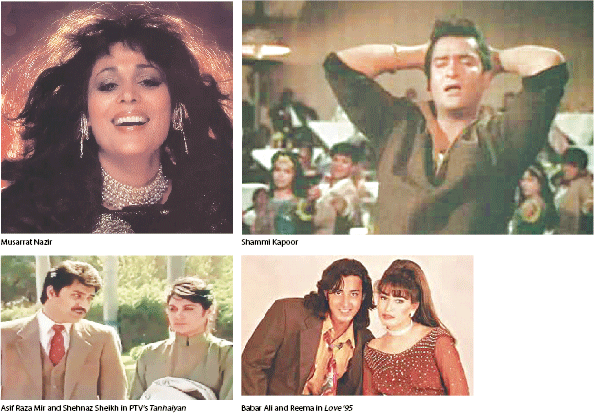
Growing up in the pre-digital era, our discoveries came late, often unexpectedly. I remember an evening in 1987 when our entire family gathered around the TV to watch Musarrat Nazir perform ‘Laung Gawacha’ and ‘Chalay tau katt hi jayega safar.’ My aunt called out to my grandfather, urging him to join us.
I looked at my then 50-something grandfather and then at the elegant, poised Musarrat on screen, thinking she couldn’t be more than in her late 30s. It was only years later that I learned she had been a screen siren during the ’50s! Nazir was approaching 50 and had delivered films such as Pattan (1955), Maahi Munda (1956), YakkayWali (1957), Zehr-i-Ishq (1958), Kartar Singh (1959), Watan (1960), Gulfam (1961) and Shaheed (1962) during the 10 years of her acting career.
My first VHS experience was the Sunny Deol-Amrita Singh starrer Betaab (1983). The actor who stood out wasn’t the young lead but Shammi Kapoor — not as a romantic hero but as the heavy-set, bearded uncle who always complicated the hero’s life. So imagine my confusion when, in films such as Vidhaata and Wanted, I saw him joyfully lip-syncing to songs and dancing with reckless abandon!
During the intermission in Betaab, a trailer appeared: Shammi Kapoor Hits. I confidently told my mother they must’ve mistakenly used Shammi’s name instead of Rajiv — his obvious lookalike nephew who had then recently debuted.
Only later did I realise that, while Musarrat was enchanting Lollywood, Shammi was electrifying Bollywood with his devil-may-care attitude and revolutionary dance moves in films such as Tum Sa Nahin Dekha (1957), Dil De Ke Dekho (1959), Junglee (1961), China Town (1962), Kashmir Ki Kali (1964) and An Evening in Paris (1967), to name just a few.
China Town was a predecessor to Don (1978) starring Amitabh Bachchan who, like Shammi, was on a pursuit of hits in the late ’70s with films such asAmar Akbar Anthony (1977), Kasme Vaaday (1978), Muqaddar Ka Sikandar (1978) and The Great Gambler (1979). Fast-forward a few decades: if I place Amitabh Bachchan in Shammi’s shoes and my own son in mine, the gap becomes even more pronounced. For him, the legendary Bachchan is the grizzled pirate from Thugs of Hindostan, not the ‘angry young man’ who once redefined Bollywood masculinity. The aura shifts. The legacy, though intact, becomes abstract.
This generational fog drifted back while watching Main Manto Nahin Hoon on ARY. Seeing veterans such as Saima, Saba Hameed, Asif Raza Mir, Babar Ali and Usman Peerzada on screen felt like leafing through the pages of a long-lost photo album.
Audiences in 2025 may not grasp the weight of these names. Usman Peerzada, who has been around since 1968, played the lead in Javed Jabbar’s Beyond the Last Mountain (1976), Pakistan’s first film entirely in English. Asif Raza Mir was a bona fide heartthrob during the late ’70s, and for many, he will always be ‘Zain’ from the evergreen Tanhaiyaan (1985). The idea of a ‘threat’ ever coming from his mouth would have once seemed unimaginable!
Babar Ali helped revive the film industry during the ’90s with hits such as Syed Noor’s Jeeva (1995) and Shamim Ara’s Munda Bigrra Jaye (1995). When Main Manto Nahin Hoon’s producer and star Humayun Saeed was still doing supporting roles, Babar was carrying films on his shoulders, and writer Khalil-ur-Rehman Qamar wasn’t even on the scene.
Saima, Babar’s contemporary, had danced and romanced across decades — opposite everyone from Shaan to Sultan Rahi, Nadeem to Moammar Rana — and is now married to the veteran filmmaker Syed Noor. Her graceful transition to supporting roles speaks volumes about her humility and strength of character.
These were the titans of late ’80s and early ’90s television and film. Watching Usman Peerzada’s screen principal have a surreal phone conversation with Asif Raza Mir’s crime lord in Main Manto Nahin Hoon brought back memories of 1979, when both men shared screen space wooing Babra Sharif in Shamim Ara’s Miss Hong Kong.
Babar Ali, another of Shamim Ara’s cinematic discoveries, made his mark in television before fully transitioning to film. His portrayal of Muhammad Bin Qasim — with his flowing locks and youthful charm — became an overnight sensation. It was a role that propelled him, almost naturally, to cinema stardom.
In Main Manto Nahi Hoon, Babar now plays father to Azaan Sami Khan’s character while Saba Hameed — earlier known as Saba Pervaiz — plays his devoted wife. While Saba is undeniably seasoned enough to play Babar’s mother, the production team chose instead to squeeze her into a role that would’ve been better suited to a younger actress. Saima, by contrast, has aged gracefully into roles that honour her legacy and her era.
Watching Saba opposite Babar felt like a misstep — as if the casting department had either a mischievous sense of humour or a blind spot for timelines. After all, Usman Peerzada, who once directed Babar in Qarz (1997), had already acted opposite Saba in Shehzad Khalil’s Teesra Kinara back in 1980 — when Babar was likely still mastering his multiplication tables.
And that, perhaps, is the bittersweet irony of screen legends — their stardom, once blinding, slowly fades into the periphery for newer generations — reduced to cameos, memes or supporting roles in franchise films. For us, Redford was the Sundance Kid long before he joined S.H.I.E.L.D. Shammi Kapoor was swagger personified before he became the bumbling old man. And Babar Ali was a heartthrob before he started playing anyone’s father.
Time doesn’t erase legacies, it reframes them. What one generation mourns as an irreplaceable loss, the next recognises as a passing name in the end credits. Perhaps that’s the quiet truth of iconicity: not just dazzle in one’s prime but to echo — however faintly — in the imagination of those who never truly saw you shine.
Published in Dawn, ICON, October 19th, 2025