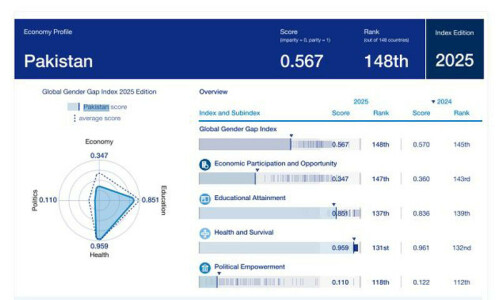
THE Global Gender Report 2025 is dark enough to recast the way Pakistan is viewed by the world. The country’s descent to the bottom 148th rank, with a gender parity mark slipping from last year’s 57pc to 56.7pc, is an unsettling comment on how male-centric narratives and cultural mores push women into a social void.
The report claims that this year’s results record a second consecutive dip from the best economic score of 57.7pc in 2023, while Pakistan’s parity in economic participation and opportunity sank by 1.3pc.
A closer look at the four key indices reveals that Pakistan’s was a downward slope on the performance graph: it came in at 147 in economic participation and opportunity — women constitute a dismal 25pc of the formal labour force — and 137 in educational attainment — the sole indication of progress as educational parity rose by 1.5pc though that is partially attributed to a decline in male enrolment in tertiary education.
In health and survival, we rank 131, and 118 in political empowerment. Our imbalanced scorecard in the main gauges that power development and prosperity reflect the shallowness of political claims.
The blame for this state of affairs falls on successive governments who failed to create protective systems, reframe patriarchal discourse, or respect the mandate for more women lawmakers.
This, along with a corrupt and biased criminal justice system, have shaped an unsafe environment where violence is a daily truth: a rape happens every two minutes due to a 3pc conviction rate.
The timid pro-women stances of female leaders strengthen the grip of misogynistic power structures that prevent parity and divergence. The Punjab chief minister’s pledge to safeguard women from abuse and harassment is questionable: only 924 suspects in a total of 60,217 cases registered across the province in 2024 were convicted; 2,388 were acquitted because of police negligence.
To claim gender parity, justice in these markers is crucial. But the assessment does raise some questions. While India, given its track record of violence against women and hate crimes, is justifiably among the lowest-ranked countries in South Asia at 131, Afghanistan’s absence is puzzling.
So is the fact that Pakistan is positioned below conflict-ridden Sudan and Yemen, where swathes of women are deprived of employment and healthcare amid internal displacement and sexual abuse.
It raises questions about the methodology adopted to arrive at these conclusions. And strangely, while the Middle East is also criticised for curbs on women, it posted a much higher jump than Pakistan. We should remember that were women’s contributions in the informal sector were documented as data, Pakistan would appear higher than nations where women are particularly dispossessed.
Published in Dawn, June 16th, 2025