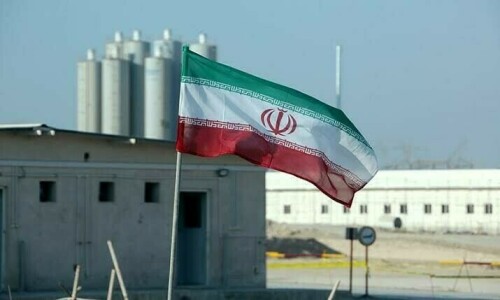
Iran said on Monday it will soon present a counter-proposal on a nuclear deal with the United States, after it had described Washington’s offer as containing “ambiguities”.
Tehran and Washington have held five rounds of talks since April to thrash out a new nuclear accord to replace the deal with major powers that US President Donald Trump abandoned during his first term in 2018.
The longtime foes have been locked in a diplomatic standoff over Iran’s uranium enrichment, with Tehran defending it as a “non-negotiable” right and Washington describing it as a “red line”.
On May 31, after the fifth round talks, Iran said it had received “elements” of a US proposal, with Foreign Minister Abbas Araghchi saying later the text contained “ambiguities”.
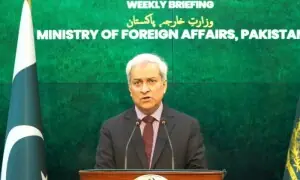
Foreign Ministry spokesman Esmaeil Baqaei criticised the US proposal as “lacking elements” reflective of the previous rounds of negotiations, without providing further details.
“We will soon submit our own proposed plan to the other side through (mediator) Oman once it is finalised,” Baqaei told a weekly press briefing.
“It is a proposal that is reasonable, logical, and balanced, and we strongly recommend that the American side value this opportunity.”
Iran’s parliament speaker has said the US proposal failed to include the lifting of sanctions — a key demand for Tehran, which has been reeling under their weight for years.
‘Strategic mistake’
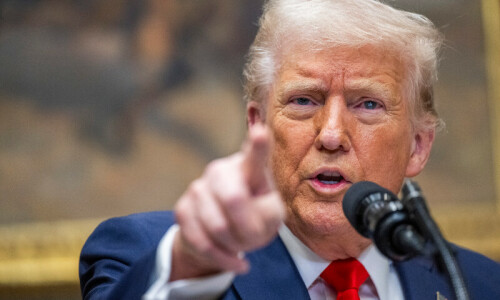
Trump, who has revived his “maximum pressure” campaign of sanctions on Iran since taking office in January, has repeatedly said it will not be allowed any uranium enrichment under a potential deal.
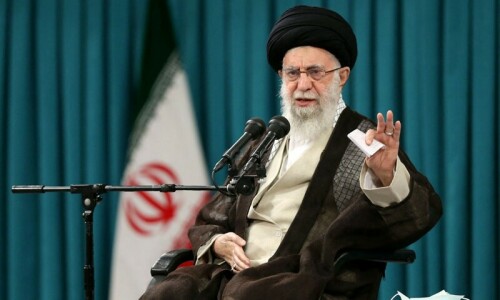
On Wednesday, Iran’s supreme leader Ayatollah Ali Khamenei said the US offer was “100 per cent against” notions of independence and self-reliance.
He insisted that uranium enrichment was “key” to Iran’s nuclear programme and that the US “cannot have a say” on the issue.
Iran currently enriches uranium to 60pc, far above the 3.67-pc limit set in the 2015 deal and close though still short of the 90pc needed for a nuclear warhead.
Western countries, including the United States, have long accused Iran of seeking to acquire atomic weapons, while Iran insists its nuclear programme is for peaceful purposes
The United Nations nuclear watchdog will convene a Board of Governors meeting from June 9-13 in Vienna to discuss Iran’s nuclear activities.
The meeting comes after the International Atomic Energy Agency released a report criticising “less than satisfactory” cooperation from Tehran, particularly in explaining past cases of nuclear material found at undeclared sites.
Iran has criticised the IAEA report as unbalanced, saying it relied on “forged documents” provided by its arch foe Israel.
Britain, France and Germany, the three European countries who were party to the 2015 deal, are currently weighing whether to trigger the sanctions “snapback” mechanism in the accord.
The mechanism would reinstate UN sanctions in response to Iranian non-compliance — an option that expires in October.
On Friday, Araghchi warned European powers against backing a draft resolution at the IAEA accusing Tehran of non-compliance, calling it a “strategic mistake”.
On Monday, Baqaei said Iran has “prepared and formulated a series of steps and measures” if the resolution passed.
“Without a doubt, the response to confrontation will not be more cooperation,” he added.