0
0


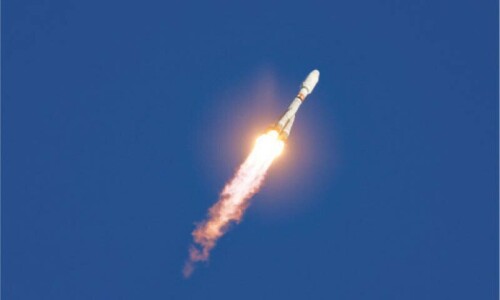
VOSTOCHNY COSMODROME: Russia launched a Soyuz rocket early on Tuesday carrying two satellites designed to monitor the space weather around Earth and 53 small satellites, including two Iranian ones, Russia’s Roscosmos space agency said.
The Soyuz-2.1 launch spacecraft, which lifted off from Russia’s Vostochny Cosmodrome, carried two Ionosfera-M satellites, which will become part of the space system for monitoring the Earth’s ionosphere, the agency said.
The ionosphere, where Earth’s atmosphere meets space, stretches roughly 50 to 400 miles above Earth’s surface, according to information provided on Nasa’s website.
Each Ionosfera-M satellite weighs 430 kg and its working orbit is at an altitude of 820 km, according to Interfax news agency.
The system will include in total four of the Ionosfera-M satellites. The next two devices are planned to be launched in 2025, Roscosmos reported.
Among the 53 small satellites are two Iranian satellites, the Kowsar, a high-resolution imaging satellite, and Hodhod, a small communications satellite, as well as the first Russian-Chinese student satellite Druzhba ATURK. Roscosmos said it was a “record number of Russian satellites simultaneously put into orbit.” Tehran said it was the first time Russia had launched privately built Iranian satellites.
Russia in February launched into space an Iranian research satellite that will scan Iran’s topography from orbit, Iran’s state media reported at the time. The two countries have deepened political, economic and military ties amid Russia’s offensive in Ukraine and the war in the Middle East, raising concerns in the West.
Published in Dawn, November 6th, 2024