Neelum-Jhelum set to resume generation by March 2028

• Senate panel seeks transparent probe into tunnel collapse, project cost escalation
• Wapda reports Rs23bn loss due to fake bank guarantee in Nai Gaj Dam scheme
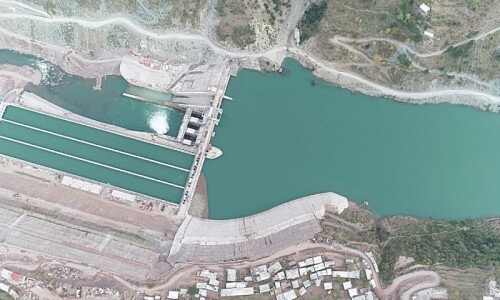
ISLAMABAD: The over Rs500 billion Neelum-Jhelum Hydropower Project (NJHPP), shut since a tunnel collapse on April 2, 2024, may resume power generation by March 2028, nearly four years after its closure.
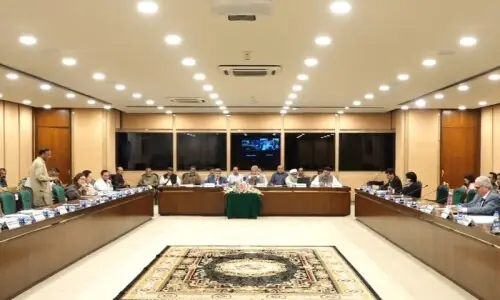
This was disclosed to a parliamentary committee on Friday by Water and Power Development Authority (Wapda) Chairman retired Lt Gen Muhammad Saeed, who also reported a Rs23bn loss caused by a fake bank guarantee submitted by the defaulting contractor of the Nai Gaj Dam project in Sindh.
The Senate Standing Committee on Water Resources, chaired by Senator Jam Saifullah Khan, was also informed that groundwater levels had been falling beyond sustainable limits, particularly in Punjab’s agricultural belt, because of overexploitation, worsening Pakistan’s water crisis despite it already being among the world’s most water-stressed countries.
Gen Saeed told the committee that despite its tunnel-related challenges, the NJHPP had been a successful project and had already recovered about 80 per cent of its cost through the supply of cheaper electricity.
He said inquiries into the tunnel failure were underway and that reports highlighting the project’s location in a seismic zone had existed before its launch. He said Wapda was committed to restoring the project and hoped to resume electricity generation by March 2028.
The Wapda chairman said Pakistan would have to address its water challenges seriously for its survival, noting that no major dam had been constructed after Mangla and Tarbela more than five decades ago, whereas India had built thousands of small and large dams.
The committee stressed that the causes of the tunnel collapse and the project’s cost escalations should be investigated through a transparent and independent inquiry. Senator Saifullah assured the government team, including officials of the Ministry of Water Resources, of the committee’s full support for an impartial investigation to ensure accountability and protect future national infrastructure projects.
The committee held a detailed discussion on groundwater depletion across the country. It was informed that groundwater levels continued to decline in several Punjab districts, including Okara, Vehari, Sahiwal, Multan and Lahore. The panel called for adopting international best practices for groundwater conservation, efficient irrigation techniques and sustainable water management to improve agricultural productivity while protecting water resources.
Sindh irrigation authorities informed the committee that around 80pc of the province’s groundwater was saline and that a provincial groundwater law was being drafted.
Senator Saifullah asked the Sindh government to provide the draft legislation to the committee for review.
Officials from Khyber Pakhtunkhwa said no comprehensive groundwater assessment had yet been carried out because of the absence of piezometer installations.
Balochistan authorities reported that annual groundwater extraction exceeded available resources, creating a significant deficit across 18 groundwater basins. They outlined plans for groundwater monitoring, construction of recharge dams and the development of GIS-based decision support systems.
The committee was further informed by the Wapda chairman that Pakistan faced an increasingly severe water crisis in the coming decades.
While discussing the Nai Gaj Dam project, Gen Saeed said the original contractor had submitted a fake bank guarantee in 2009, resulting in a financial loss of about Rs23bn. The contract was subsequently terminated, the contractor blacklisted, and the matter was currently pending before the Supreme Court.
The committee endorsed the ministry’s position and stressed the need to ensure accountability while expediting completion of the project, which has the potential to irrigate about 28,000 acres of land.
The committee also received updates on several major water projects, including Hingol Dam, Harpo Dam, Kachhi Canal, RBOD-I and RBOD-III, and reviewed issues related to waterlogging and drainage infrastructure.
Reviewing Public Sector Development Programme (PSDP) allocations for the current financial year, the committee expressed concern over a substantial funding shortfall for water and power projects.
Published in Dawn, July 11th, 2026