The rise in foreign exchange reserves and increase in exports and remittances sound like good news; however, the high level of indebtedness keeps Pakistan vulnerable.
The occasional rise in tax revenue collection and panned austerity measures of the government puff up the optimism of many among us. Unfortunately, structural fiscal weaknesses (the ever-rising cost of debt servicing and the ever-increasing cost of running the government) keep the country trapped in the domestic debt cycle and prevent pro-growth expenses.
Some think this situation requires the formulation of new economic revival policies and growth. Long-term economic policies work well in countries where the implementors of policies are morally upright, the level of trust between different state institutions is high, and where there is enough political stability.
Pakistan has long been experimenting with several models of forward planning with little and sometimes counter-productive results. The Federation of Pakistan Chambers of Commerce & Industry (FPCCI) has recently launched a grand think-tank for Pakistan’s Economic Revival and Growth (FPCCI-PERG).
Most long-term economic plans fail when a new regime discards initial policies, creating serious challenges of inconsistency
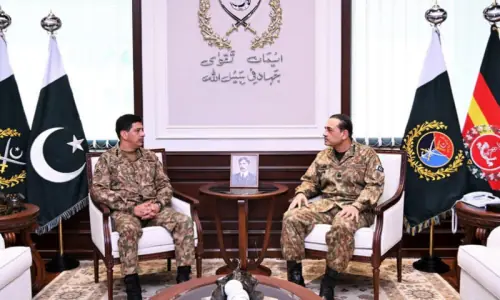
Alas, its recommendations, too, would make little contribution towards long-term economic growth if the civil-military hybrid model of governance remains undefined yet fully functional; the sovereignty of parliament and independence of the judiciary remain vulnerable to manipulation and intimidation; and political stability remains missing.
From a scholarly point of view, it is important to analyse the context of long-term planning. The problem with most of our economic plans is that their implementation halts with the regime change, and the new regime either entirely or partially discards those plans, thus creating inconsistency in economic policies — a thing that industrialists and businesses abhor. Besides, inconsistent economic policies also discourage inflows of foreign investment in the country.
During the present hybrid regime, the creation of the civil-military-run Special Investment Facilitation Council (SIFC) has so far obtained commitments of billions of dollars worth of foreign investment. However, the problem is that the nation is still unsure of the future of the SIFC itself. How a regime change will affect the efficacy of this institute is a relevant question. However, no one can answer it with certainty in an environment of ever-increasing political polarity and mistrust between various state institutions.
The FPCCI should ensure that its new think-tank is not used as a vehicle for winning wider support for specific sections of society
Though President Asif Ali Zardari is credited for the role he played in the formulation of the 18th Constitutional amendment that aims to empower provinces, more than a decade has passed since the unanimous adoption of this amendment and provinces — particularly Khyber Pakhtunkhwa and Balochistan — continue to cry for economic autonomy.
Even Sindh, the home province of President Zardari, has a long list of grievances with the federal government, including those regarding water sharing. The chief reason behind this situation may be that the establishment never approved of the 18th Constitutional Amendment.
The external context of long-term planning has also played a key role in determining the quality of its implementation and net outcomes. More than a decade-old history of the China-Pakistan Economic Corridor (CPEC) planning is an example.
Pakistan’s geopolitical and geostrategic compulsions are real, and this reality becomes even more demanding every year as the debt-trapped country struggles more and more with ever-increasing requirements of meeting external financing gaps.
That’s where the International Monetary Fund (IMF) comes into the picture, with its growth-stunting bailout programmes further complicating the domestic challenges of security and political polarity.
To meet these challenges, Pakistan needs to balance policies with the apparent aim of seeking greater immediate economic help from China (both through CPEC, state, and commercial funds) and Gulf Cooperation Council countries and maintaining good working relations with the West, particularly with the US and the UK.
These and similar challenges, including the ones that have popped up with the amazing advancement in technology and deterioration of the environment, are too significant to be handled without first achieving political stability in the country. The political class and the establishment both understand this, but the problem is some political leaders and some elements in the deep state are too stubborn to let go of their mutual grievances for the larger interest of the nation.
From making deliberations and the creation of FPCCI-PERG to analysing the problems and recommending remedies, the FPCCI ought to make sure that truth prevails over assumptions and that its new think-tank is not used as a vehicle for winning wider support of the business community for a particular class of politicians or the establishment.
If it begins and continues to work on merit, it can contribute significantly to its avowed objective.
Published in Dawn, The Business and Finance Weekly, September 23rd, 2024