DURING his stay in England for a degree from Cambridge between 1905 and 1907, Allama Muhammad Iqbal had decided to quit poetry as he felt it was useless and a waste of time. Sheikh Abdul Qadir, his friend and the editor of Makhzan, happened to be there in London in those days and tried to persuade Iqbal to continue composing poetry. As mentioned by Abdul Qadir in his preface to Iqbal’s first collection of Urdu poetry Baang-i-Dara (1924), Iqbal was determined and wanted to forsake poetry for good. Finally, it was decided to take advice from Prof Thomas Arnold, Iqbal’s teacher who had taught him for about four years at Lahore’s Government College. Luckily, Arnold convinced Iqbal to keep on writing poetry.
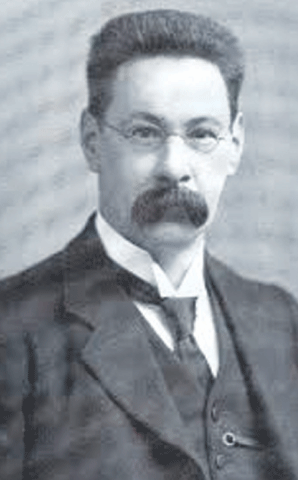
Thomas Walker Arnold was an orientalist and his domain of activity was philosophy, history, Islam and painting. Thomas Walker Arnold was born on April 19, 1864, in Devonport, district of Plymouth, England. C.E. Buckland in his Dictionary of Indian Biography and Dr Abdul Bari in his article published in January-September 1985 issue of quarterly Fikr-o-Nazar, Aligarh, have given some biographical details. According to them, Thomas Arnold was educated at Cambridge where he studied, among other disciplines, Sanskrit. He knew French, German, Persian and Arabic. Shibli No’mani learnt French from Arnold and some critics have mentioned that Shibli helped Arnold study some classical Arabic texts, as Arnold had joined Muhammadan Anglo Oriental College (MAO), Aligarh (a university later on) in December 1887 where he taught philosophy and English. Once at Aligarh, Arnold transformed his personality and adapted eastern ways, wearing kurta pajama. Sir Syed Ahmed Khan, the founder of MAO College, was proud of Arnold and once wrote: “We are proud to have gathered at our college Maulana Hali, Maulana Shibli and Mr Arnold, who should be called Maulana Arnold”.
Arnold had a special corner for Urdu in his heart and encouraged students to take part in Urdu debates and Urdu article writing contests. He would ask Shibli to adjudge the writing contest. Arnold resigned from MAO College in 1897 and joined Government College, Lahore (now a university), to teach philosophy. He also served as dean of Punjab University Oriental College, Lahore. In the year 1897, Iqbal had passed his BA from Government College with English, Arabic and philosophy being his majors. Arnold had a reputation from MAO College to be erudite, kind and helpful. So Iqbal felt lucky to be Arnold’s student and took admission to MA philosophy.
Two teachers influenced Allama Iqbal most: Syed Mir Hasan and Thomas Arnold. Iqbal always spoke highly of them both. At Government College, Arnold was all praise for Iqbal’s brilliance and advised him to go to Europe for further studies. In 1904, Arnold decided to go back to England. Iqbal wrote a farewell poem and paid glowing tributes to his teacher and mentor. Titled Nala-i-Firaq, the poem is included in Baang-i-Dara. Later on, while Iqbal was at Cambridge, Arnold persuaded him to do his PhD and go to Germany for the purpose. Iqbal did just that and was finally awarded a doctorate from Munich’s university in 1907 on his dissertation titled The Development of Metaphysics in Persia.
Returning to England, Arnold joined India Office Library. From 1921 till his death he was Prof of Arabic and Islamic studies at London University. As for Arnold’s academic contribution, his book The Preaching of Islam — subtitled A History of the Propagation of the Muslim Faith — earned kudos for its unbiased views on spread of Islam, as Arnold stressed that Islam did not spread by the sword. He finished the book while at Aligarh and the preface to the first edition, published from London, shows the place and date of writing it as “Aligarh, 1896”. It was translated into Urdu and Turkish and the second edition appeared from London in 1913. At least three reprints were published by Lahore’s Sh. Muhammad Ashraf in 1960s and 1970s.
Legacy of Islam, a collection of articles on Islam, co-edited by Arnold with two other scholars, had an article by Arnold on ‘Influence of Islamic Art on Europe’s Paintings’. Abdul Majeed Salik later on translated it into Urdu. In 1902, Arnold published Al-Mutazilah, an English translation of a chapter from an Arabic manuscript, with annotations, as mentioned by Dr Abdul Bari. Arnold’s other books include: The Caliphate, Survivals of Sasanian and Manichaean Art in Persian Painting, The Islamic Book, Painting in Islam: A Study of the Place of Pictorial Art in Muslim Culture, The Islamic Faith, The Old and New Testaments in Muslim Religious Art and some others. Arnold wrote introduction and notes to Laurence Binyon’s The Court Painters of the Grand Mogals. Arnold was the first English editor for the first edition of The Encyclopaedia of Islam.
Thomas Walker Arnold died in London on June 9, 1930.
Published in Dawn, June 3rd, 2024