KARACHI: Despite mounting optimism for increased inflows and a new IMF bailout package, the US dollar strengthened in the inter-bank market while the State Bank’s reserves saw a slight decline.
A financial team led by Finance Minister Muhammad Aurangzeb is currently in Washington seeking another loan package from the International Monetary Fund.
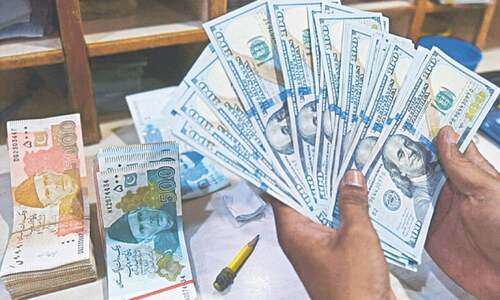
Despite the minister’s hopeful outlook before departing for the negotiations, the market remained indifferent to these developments. On Monday, the dollar appreciated by 18 paise to Rs278.12. The greenback saw a 29-paisa increase in the open market, reaching Rs279.66.
Currency experts assert that the market is driven by tangible realities, emphasising that only actual dollar inflows can sway market sentiments; good news is not enough.
State Bank reserves see a slight decline
There is a pervasive sense of disillusionment in the currency market regarding the country’s increasing foreign debt and debt servicing burden. Experts see little prospect of escaping the substantial debt servicing obligations consuming a significant portion of Pakistan’s export earnings.
A senior banker remarked that avoiding the $25 billion debt servicing in FY25 appears impossible, especially with the necessity for further borrowings to meet financial obligations.
Last week, the State Bank of Pakistan (SBP) disbursed $1 billion against maturing Eurobonds, depleting the central bank’s already modest reserves.
Although the State Bank on Monday reported a marginal decrease of $0.1 million to $8.040bn in its foreign exchange reserves during the week ended on April 5, this figure did not account for the $1bn Eurobond payment. Currency experts estimate the actual reserves post-payment to be around $7bn.
Nevertheless, the SBP intends to bolster reserves by purchasing dollars from the inter-bank market, as it has been doing to maintain reserves at a targeted level of $9bn by the end of this fiscal year under the IMF Standby Arrangement.
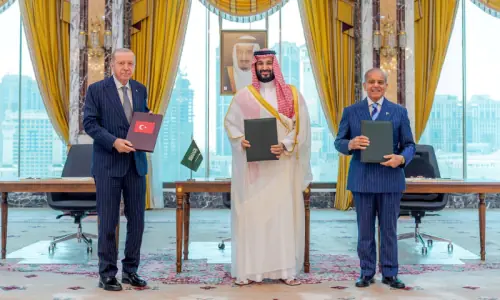
As a high-level Saudi delegation is currently in Pakistan, Islamabad is pinning hopes on investment from the kingdom, which is interested in injecting $5bn across various sectors in Pakistan.
March witnessed a notable influx of $3bn in remittances and over $82m in treasury bills, marking a significant uptick after four years. However, bankers caution that this trend in T-bill inflows may not persist due to declining returns.
The current return rate on T-bills stands at approximately 21 per cent, a level considered high, and stable exchange rates over the past three months have encouraged investors to enter the market.
The State Bank reported the country’s total reserves stood at $13.441bn, including $5.4bn held by commercial banks during the week ended on April 5.
Published in Dawn, April 16th, 2024