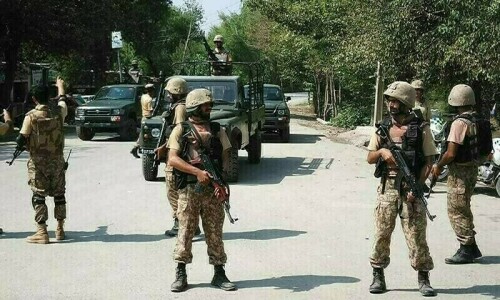
APART from political and financial crises, the outgoing year will be remembered for the high number of terrorist attacks the country witnessed, particularly targeting civil and military security men. Three separate attacks in KP’s Dera Ismail Khan district on Monday and early Tuesday are an unfortunate reminder of the ferocity militants are capable of.
According to ISPR, the deadliest attack took place in the Daraban area, where terrorists rammed an explosives-laden vehicle into a military check-post, followed by a suicide bombing. At least 23 troops were martyred in the attack, while six terrorists were reportedly killed.
Two other engagements took place in the Darazinda and Kulachi areas respectively, resulting in the martyrdom of two more soldiers, as well as the deaths of numerous terrorists. The Daraban attack has been claimed by the shadowy Tehreek-i-Jihad Pakistan, believed to be an avatar of the banned TTP, and has resulted in the highest loss of troops in a single attack this year.
D.I. Khan and adjacent districts in KP, as well as neighbouring areas of Punjab and Balochistan, have seen the greatest frequency of militant activity in the current year. November’s Mianwali air base attack, as well as July’s Zhob garrison attack — both believed to be the handiwork of TJP — have occurred in the same geographical region, whilst several other deadly incidents in D.I. Khan and nearby districts have occurred throughout the year.
The militants have seemingly changed their tactics compared to the terrorist campaigns of a decade ago. Rather than attacking civilians in the cities, they have chosen to focus on military and police personnel. This has resulted in disturbingly high casualty rates amongst security men.
According to the Pakistan Institute for Conflict and Security Studies, up till November around 600 militant attacks had occurred in Pakistan, causing nearly 900 fatalities. This is said to be an 81pc escalation in attacks over those in 2022.
The situation is indeed grim, but the challenge must be handled resolutely. Too many lives, particularly of our brave security men, have been lost in terrorist rampages, and the time for decisive action has come. Moreover, an election is on the horizon, and terrorists cannot be allowed to thwart the democratic process.
Therefore, both the caretaker government and the security establishment must address the militant menace determinedly. As stated above, most of the recent attacks have been concentrated in one geographical area, so targeted action in this particular region is essential to either capture or neutralise militants.
If this is not done, more widespread military operations may be required, resulting in the dislocation of civilian populations. Furthermore, whilst it may be difficult to deal with the Afghan Taliban, channels need to be kept open, and pressure applied so that terrorists are unable to find sanctuary in Afghanistan.
Published in Dawn, December 13th, 2023