WHEN caretaker finance minister Dr Shamshad Akhtar said that the ‘interim’ government wasn’t empowered to provide meaningful relief to the working masses ravaged by exorbitant electricity bills, she inadvertently acknowledged some truths about who runs Pakistan.
Ours is one of the most opaquely governed countries in the world. But present circumstances have clarified there is no democratic ‘transition’ happening here. Only by clearly naming the hydra-headed monster that rules us do we provide ourselves an opportunity to turn popular rage into something resembling a mass movement for change.
The establishment: It can be argued that more ordinary Pakistanis than ever are now clear that the military establishment is the ultimate arbiter of power in Pakistan. The way in which the PDM regime was propped up, Imran Khan and PTI cut to size, the continuing impunity over enforced disappearances, the criminalisation of independent dissenting voices (like Ali Wazir and Imaan Mazari) and the mockery made of the Constitution during and after the formation of the caretaker government illuminates who pulls the strings.
But the establishment is not a monolith. There is substantial factional struggle for power and resources within it, and this includes elements in the media, judiciary and mainstream political parties. Finally, and arguably most importantly, the establishment’s corporate footprint is now so large that millions are consciously or otherwise part of its economic empire, which include border trade, land/ resource grabs, and business ventures in sectors as diverse as real estate and fertiliser.
There is no democratic ‘transition’ happening here.
IMF and bilateral donors: Dr Akhtar let the proverbial cat out of the bag when she said that the caretakers’ primary task is to ensure that the IMF’s most recent list of conditionalities is implemented. Unfortunately, too many ‘experts’ insist that the IMF and other donors are wise and the brown sahibs who directly occupy formal seats of government are exclusively responsible for our economic crisis.
But even in the power sector’s case, the evidence is clear: the IMF and World Bank foisted the same IPPs on the country in the 1990s which suck dollars from the exchequer to this day. And, of course, the IMF has no qualms about jacking up electricity prices on the masses. Our own rich and powerful are certainly part of the problem because they refuse to pay direct tax on their incomes, but donors are far from blameless for the trials and tribulations of Pakistanis. Next is the widely expected hike which will take the price of petrol beyond Rs300.
Business-landed power: From real estate moguls to sugar cartels to construction companies, Pakistani business elites are amongst the most insular and self-interested anywhere. Gone are the days that our businessmen thought of themselves as contributing to a larger project of economic independence from global elites. Today, the vast majority of business segments choose to become subcontractors of MNCs, destroy nature and dispossess the poor, and/ or favour unregulated flows of capital in and out of the country to make a buck.
Meanwhile in rural Pakistan, landed classes remain deeply entrenched. They control thanas, katcheris and patwaris, deploy patriarchal violence and manipulate poll outcomes. Finally, big and even medium trader-merchant segments remain power players. They not only dodge taxes, but also represent a deep-seated historical sensibility that accords more political and economic importance to trade over manufacturing industry.
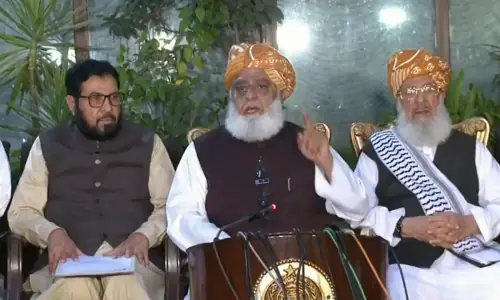
Religious right: The establishment’s historical patronage of the religious right is old news; various factions now have independent, organic roots. The Taliban are wreaking havoc in the tribal districts and other parts of KP, while there are any number of sectarian-militant organisations that operate in Gilgit-Baltistan, Balochistan and other parts of the country, empowered by formal legislation (like anti-Shia/ blasphemy bills). The TLP is back in favour with the deep state; Jaranwala appears to be only the tip of a very large iceberg.
The religious right is powerful at an ideational level and also a major source of social mobility. It is thus a major plank of the contemporary hegemonic order, and as the economic situation continues to worsen, is the most likely contender for popular mobilisation outside of the mainstream parties.
The people: Is there any hope for the mass of working people beyond ideologies of hate? There could be; however, this requires otherwise courageous but divided progressive segments to demonstrate vision and maturity. Those who rule us will continue to preside over an ever-worsening downward spiral, so the space for a meaningful popular alternative to an increasingly volatile and conflict-ridden status quo is there to be taken.
The writer teaches at Quaid-i-Azam University, Islamabad.
Published in Dawn, September 1st, 2023