0
0

The military junta that seized power in Niger in a coup last month has said it will prosecute ousted President Mohamed Bazoum for high treason over his exchanges with foreign heads of state and international organisations.
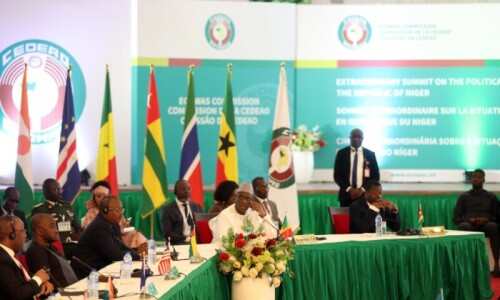
The coup leaders have imprisoned Bazoum and dissolved the elected government, drawing condemnation from global powers and West Africa’s regional bloc ECOWAS, which decided last week to assemble a standby military force that could intervene to reinstate Bazoum.
At stake is not just the fate of Niger — a major uranium producer and Western ally in the fight against an insurgency — but also the influence of rival global powers with strategic interests in the region.
Junta spokesperson Colonel Amadou Abdramane said in a statement read out on state TV late on Sunday that the military authorities had “gathered the necessary evidence to prosecute the ousted president … for high treason and undermining the internal and external security of Niger”.
United Nations spokesperson Stephane Dujarric said the attempt to bring charges against Bazoum was “very worrying”.
ECOWAS condemned the move and, like the UN, reiterated its call for Bazoum to be released and reinstated immediately.
“[This] represents another form of provocation and contradicts the reported willingness of the military authorities in the Republic of Niger to restore constitutional order through peaceful means,” the regional bloc said in a statement.
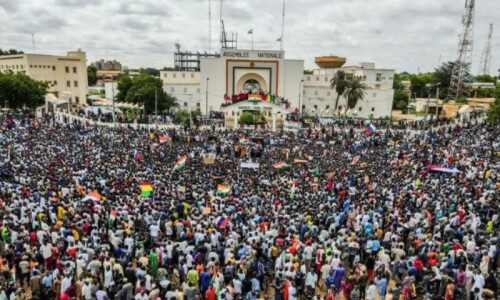
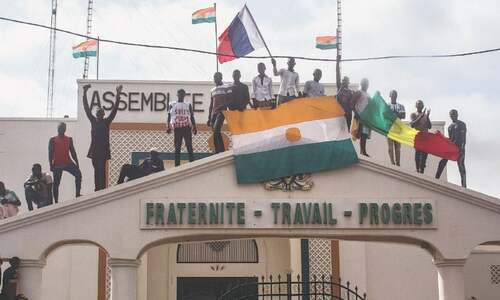
Residents of Niamey, many of whom were deeply disillusioned with Bazoum’s government and are supporting the coup leaders, said they backed the prosecution of the deposed president.
“This comes as no surprise given that you’ve heard the various declarations and appeals [he made] to the international community not only to impose sanctions but also to intervene militarily on Niger’s territory,” said Illiassou Boubacar, a civil society activist in his 50s.
“But what we would like is for it to be carried out according to the rule book, respecting all procedures and hiring magistrates with the skills required to do the job.”
Mucahid Durmaz, senior West Africa analyst at risk intelligence company Verisk Maplecroft, said the junta wanted to diminish Bazoum’s legitimacy and dissuade foreign powers from trying to reinstate him.
“The prosecution of Bazoum will likely force ECOWAS to soften its stance against the junta and focus on establishing a transitional deal to allow for a return to democratic governance,” he said.
‘Misinformation’
Abdramane, the junta spokesperson, also said there was a misinformation campaign against the junta to try to “derail any negotiated solution to the crisis in order to justify military intervention … in the name of ECOWAS”.
The junta rebuffed several diplomatic missions in the first two weeks after the coup, though it has signalled a potential willingness to engage since ECOWAS said it would “activate” standby troops for possible use in Niger.
The ECOWAS parliament on Saturday said it wanted to send a committee to meet the junta in Niamey, but the proposed timing of that mission is not clear.
The African Union, the European Union, the United States and the United Nations have all said they are worried about the conditions in which Bazoum is being kept.
Bazoum’s political party has said his family has no access to running water, fresh food or doctors, and Bazoum told Human Rights Watch that his son needed to see a doctor because of a serious heart condition.
The junta said on Sunday that Bazoum was regularly seeing his doctor and that the last visit was on August 12.
“After this visit, the doctor raised no concerns about the state of health of the ousted president and members of his family,” Abdramane said.
The Peace and Security Council of the 55-nation African Union was meeting on Monday to discuss the situation in Niger, a sign of the level of concern over the possible fallout from West and Central Africa’s seventh coup in three years.
US, French, German and Italian troops are stationed in Niger, in a region where local affiliates of militant groups al Qaeda and Islamic State have killed thousands and displaced millions.
Meanwhile, Russian influence has grown as insecurity increases, democracy erodes, and leaders seek new partners to restore order.
Western powers fear Russia’s clout could increase if the junta in Niger follows Mali and Burkina Faso, which ejected the troops of former colonial power France after coups.