0
0
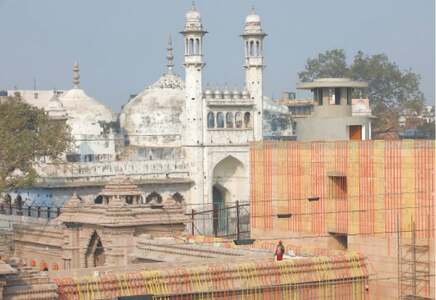
NEW DELHI: Authorities on Friday began the survey of Varanasi’s Gyanvyapi mosque, built by Mughal Emperor Aurangzeb, after the Indian apex court cleared the passage with instructions not to do anything invasive.
Varanasi — a city in the northern Indian state of Uttar Pradesh — has been the two-term parliamentary constituency of Prime Minister Narendra Modi, who pioneered the Hindutva campaign that led to the demolition of the Babri mosque in 1992. A law passed by the Narasimha Rao-led government forbids new legal claims on or damage or destruction of religious monuments other than the Babri mosque which was being disputed at the time.
According to the media reports, the Archaeological Survey of India (ASI) has been given four weeks to submit its report to a court in Varanasi. However, the mosque committee had challenged the district court’s survey order in the Allahabad High Court.
On Thursday, the high court dismissed the request by the mosque committee, which sought to stop the district court’s order directing the ASI to conduct the survey to determine if the mosque was built on a pre-existing temple.
The committee finally went to the Indian Supreme Court, which heard the matter on Friday. The Anjuman Intezamia Masjid Committee said the ASI survey of the Gyanvapi mosque will go into history and will “reopen wounds of the past... History has taught us something. What happened in December 1992, that raises suspicion and distrust at every step,” the mosque committee’s lawyer Huzefa Ahmadi said.
“The ASI survey intends to go into the history as to what happened 500 years ago. It would reopen wounds of the past,” Mr Ahmadi said.
“Let’s not get into the past now,” a bench of Chief Justice of India DY Chandrachud and Justices JB Pardiwala and Manoj Misra observed. After the Supreme Court ordered the ASI to use a non-invasive method in its survey, Solicitor General Tushar Mehta, appearing for ASI and the UP government, promised no excavation work will be done and no structure inside the mosque will be harmed.
The ASI on Friday resumed its scientific survey of the Gyanvapi compound. The survey began at 7am (local time); it stopped for two hours to allow for Friday prayers, a news agency PTI reported.
A large number of security personnel has been deployed by the district authorities to ensure law and order near the Gyanvapi complex. A decades-old litigation around the mosque has gained momentum over the last year or so after five Hindu women sought the right to worship Maa Shrinagar Gauri on the outer wall of the mosque complex.
Published in Dawn, Aug 5th, 2023