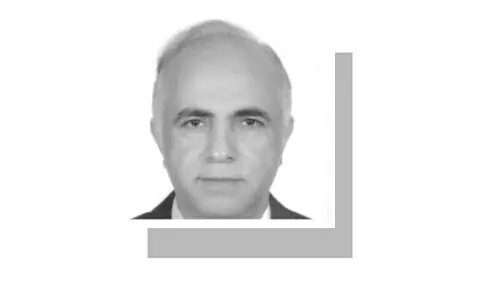
Dialogue with India on levels other than military ‘need of Pakistan’, says former DG ISPR Athar Abbas

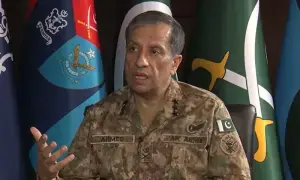
Former Director General (DG) of the Inter-Services Public Relations (ISPR), Major General (retd) Athar Abbas, said on Sunday that dialogue with India on levels other than the security establishment’s is “a need of Pakistan”.
He made the remarks during a panel discussion — titled Search for peace and security among neighbours — on the final day of the 14th Karachi Literature Festival held at Karachi’s Beach Luxury Hotel.
Abbas said, “Dialogue is, at present, a need of our country […]. The way forward is not just the state apparatus, because if you leave it [solely] to the security establishment, there will be no move forward. It will be like taking one step forward and two steps backwards.
“There has to be an initiative […] like track II diplomacy, like media, like business and trade organisations, like academia … and they can interact and create their space within Indian society, etc.
“That builds pressure on the [Indian] government [and] state authorities that they must look into what the people are saying. This is a requirement of time that dialogue is a need of Pakistan.”
If met with resistance, he said, Pakistan could also involve “external actors” such as the US and the European Union.
When asked how soon he saw any talks with the neighbours taking place, Gen Abbas said, “You cannot change your neighbour. Eventually, they will have to come to a negotiating table […] even if it feels it is a great power.”
The former DG ISPR remarked that instability in Pakistan would also spill over into India and vice versa, and that “we should not only wait for the establishment” and look towards other options as well.
He said there had been “missed opportunities” in the past by both countries to initiate talks, as he recalled former Indian prime minister Atal Bihari Vajpayee’s bus diplomacy and Gen Musharraf’s Agra initiative“.
Abbas said it would be hard to talk to a state that “is at war with itself”, as he referred to the political rifts rampant in the country.
Separately, foreign relations analyst Michael Kugelman pointed out during the discussion that even though India and Pakistan would always have tensions, the Line of Control has been “relatively quieter” in recent years.
He did not see any improvement between the two countries’ relations in the future, adding, “I think that’s a shame [as] both countries can benefit from economic relations.”
Meanwhile, Dawn columnist Zahid Hussain remarked that while there was no danger of both countries going to war in the current “no peace, no war” situation, neither did he see any improvement in the relations.
Noting that it was the first time that both India and Pakistan had “demoted their diplomatic relations” and there were no talks on any issues, he said the “mood in Pakistan [regarding relations with India] has also changed” recently.
Talking about the US involvement in the region’s politics, Kugelman said Washington desired peace in the region and “certainly better relations between India and Pakistan”.
“The US would prefer to see a region where China is not a dominant power,” he added.
To this, Gen (R) Abbas relayed local experts’ opinion, saying, “Experts, here, believe that the US [simply] does not want to see China as the dominant power but at the level of Pakistan, it wants to see a controlled chaos”, referring to the establishment’s concerns regarding US intentions.
Kugelman’s point of view was again different from this. He said the US did not desire instability in the region as “Pakistan is a nuclear power and controlled chaos is never far away from [becoming] an uncontrolled chaos”.