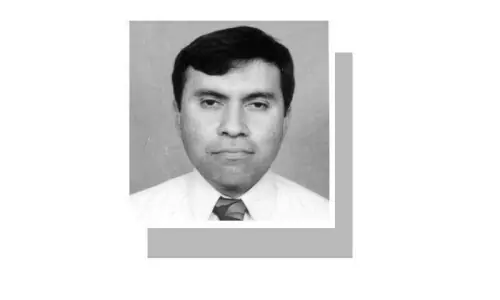
NEW DELHI, Dec 10: The Agra summit between President Pervez Musharraf and Indian Prime Minister Atal Behari Vajpayee was not a failure, and crucial progress from it could be the basis for future talks between the two sides, Pakistan’s envoy to India, Aziz Ahmed Khan, said on Tuesday.
Mr Khan, on a visit to Kolkota, the first outing away from New Delhi by a Pakistani diplomat since relations soured in December 2001, said at a meeting of the Bengal Initiative, a peace NGO, that his tour reflected the improvement in bilateral ties.
Delivering a keynote address on the theme of “Pakistan-India Relations: The Great Divide,” Mr Khan said: “We in Pakistan, however, see it differently and the reason is simple. We firmly believe that Pakistan and India are not destined to live as adversaries forever.”
He said Mr Vajpayee’s assurance of participation in the Saarc summit in Islamabad next month had “induced an element of certainty in moving the Saarc process forward in the best interest of all South Asian neighbours.”
These positive developments have not only aroused great public interest in Pakistan and India, they have also generated great hope for the development of cooperative and more productive relations between our two countries, Mr Khan said.
The envoy said Pakistan sincerely hoped that the momentum generated by recent measures would lead to an early resumption of a dialogue to address all outstanding issues, particularly the Kashmir dispute.
“Frankly, in our view, only one issue — the Kashmir dispute — has been at the root of perpetual tension and hostilities between the two countries. The sooner we accept this as an objective reality, the better it would be to open ways for a meaningful dialogue and productive engagement between our two countries.”
He said Pakistan considered all other issues minor irritants, which would fall in place once a credible mechanism to address the main obstacle had been set in motion.
He said Gen Musharraf’s four-point formula for the solution of the Kashmir issue by eliminating the options not acceptable to the parties concerned and then on that basis working for a solution acceptable to all the three parties — Pakistan, India and the Kashmiris - provided a sound basis for a way forward.
Mr Khan said although much has been said and written on the Agra summit of July 2001, he would still stress that despite it being inconclusive (we do not think it failed), valuable progress was made in evolving a framework for future engagement between the two countries.
“The issues of Jammu and Kashmir; peace and security, and terrorism and drug trafficking, were proposed to be discussed at the political level while economic and commercial cooperation, Siachen, Wullar Barrage, Sir Creek and promotion of friendly exchanges in various fields, were to be addressed at the technical level,” he said.
“The progress made at Agra still provides a valuable foundation to the two sides to pick up the threads from where they were left off and carry the process forward,” Mr Khan said.