NSC meeting reiterates 'zero tolerance' against terrorism

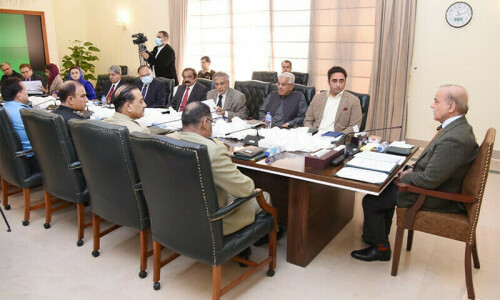
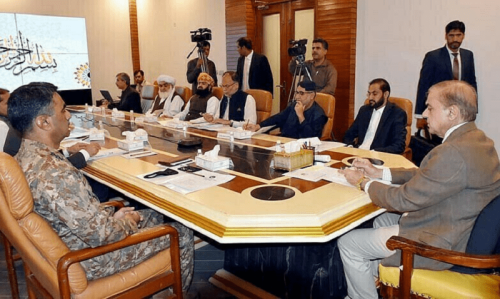
The second round of the National Security Committee (NSC) meeting convened on Monday reiterated its resolve to have "zero tolerance" for terrorism in the country, according to the Prime Minister's Office (PMO).
The moot — the principal decision-making forum on foreign policy and national security — was attended by senior civilian and military leaders with key matters of security and the economy on the agenda.
A press release issued by the PMO after the meeting's conclusion said the NSC reaffirmed its determination to take on "any and all entities that resort to violence", adding that any violence would be dealt with the "full force of the state".
"Pakistan’s security is uncompromisable and the full writ of the state will be maintained on every inch of Pakistan’s territory," the press release reads.
It added that the committee was apprised of the country's security situation of the country with a particular focus on recent terrorist incidents in Khyber Pakhtunkhwa and Balochistan.
Prime Minister Shehbaz Sharif emphasised that the war against terrorism will be led by federal and provincial governments as per the National Action Plan in accordance with the National Internal Security Policy with "people-centric socio-economic development" as the priority.
Meanwhile, the armed forces will provide "resolute deterrence and secure a conducive and enabling environment".
"Provincial Apex Committees are being revived in full earnest and LEAs (law enforcement agencies), especially CTDs (counter terrorism departments), will be brought up to the required fighting standards with requisite capabilities.
"The forum concluded that no country will be allowed to provide sanctuaries and facilitation to terrorists and Pakistan reserves all rights in that respect to safeguard her people," the press release reads.
Last week, in the opening round, the high-level body vowed to eradicate terrorism with full force and without any distinction before postponing the moot till today so decisions could be finalised in view of proposals.
Since it is quite unusual for the NSC meeting to enter a second round, it was believed that decisions would be taken not only to deal with terrorism but also to stabilise the country’s crippling economy.
A source in the government, following Friday's opening round, had told Dawn that the civil and military leadership resolved that Pakistan, which remained the worst victim of terrorism in the world, had gained peace after a long war on terror that began in 2001.
The state will not allow terrorism to resurface because peace was gained through the sacrifices of thousands of Pakistani citizens, it added.
Over the past few months, the law and order situation in the country has worsened, with terrorist groups like the outlawed Tehreek-i-Taliban Pakistan (TTP), the militant Islamic State group, and Gul Bahadur Group executing attacks with near impunity across the country.
Insurgents in Balochistan have also stepped up their violent activities and formalised a nexus with the TTP.
The incident at the Khyber Pakhtunkhwa police’s Counter-Terrorism Department interrogation centre in Bannu and the suicide bombing attempt in Islamabad not only set off alarm bells in the power corridors but also left several countries worried about the security of their nationals.
‘National security revolves around economic security'
The NSC moot also deliberated on the economic situation of the country and underscored that comprehensive national security "revolves around economic security", adding that a country's sovereignty and dignity are stressed without "self-sufficiency and economic independence".
"The forum undertook a comprehensive view of the ongoing economic situation vis-à-vis challenges being faced by the common people of Pakistan, particularly the lower and middle-income classes.
"The finance minister briefed the forum about the economic stability roadmap of the government, including the status of discussions with international financial institutions, exploring other financial avenues based on mutual interests as well as relief measures for common people," the press release reads.
It added that the committee agreed on taking concrete steps to strengthen the economy such as import rationalisation and curbing illegal currency outflows.
"Emphasis will be specially made to improve agricultural output and manufacturing sector to ensure food security, import substitution and employment. It was resolved that people-centric economic policies with trickle-down effects on common people will remain a priority. It was also agreed to involve all stakeholders for consensus to realise effective and fast-track economic recovery and road map," the press release reads.
Regarding the issue of mitigating challenges faced by the country's 33 million flood affectees, the NSC resolved to mobilise all resources for their rehabilitation and reconstruction in coordination with the provincial governments and multilateral financial institutions.
The forum also "appreciated the ongoing relief efforts led by the prime minister and federating units", the press release added.