Smart lockdown imposed in 17 localities after rising Covid cases in Hyderabad

HYDERABAD: Hyderabad administration imposed smart lockdown in 17 localities of the city’s six union committees on Monday in the wake of rising cases of coronavirus in the second wave of Covid-19 pandemic.
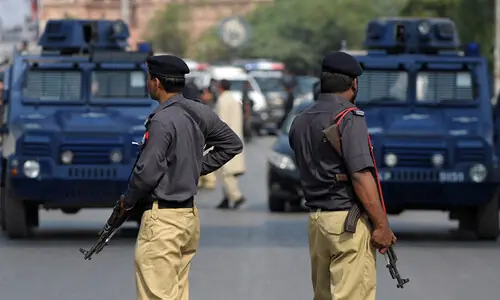
The lockdown announced late on Sunday night was to begin from Monday morning and last till Dec 5. Police closed entry and exit points of the locked down localities with barbed wire and allowed people in after they produced national identity cards.
The areas under the lockdown included several blocks in Unit-6 of Latifabad, Nasim Nagar, Wadhu Wah Road, Bhitai Town, Bhitai Nagar, Citizen Colony, Gulistan-i-Sajjad, Alamdar Chowk in Qasimabad, Diplai Memon Colony, Isra Village and Ink City in Qasimabad, Baldia and Sahafi colonies, and Gulistan-i-Fatima in City taluka.
In many areas, police were seen only guarding the roads for want of police force and in some areas people were seen without face masks.
About 11,335 people live the affected areas where 163 active coronavirus cases were reported. The lockdown appeared effective in Unit-6 of Latifabad where police ensured that all businesses pointed out in the lockdown plan remained closed.
In some cases, the area’s residents exchanged hot words with police when they were not allowed to enter the area from alternative routes. But finally police allowed them to enter after verification of identity cards.
One of the main markets in Nasim Nagar remained shut and Wadhu Wah Road was closed with barbed wire while Qasimabad assistant commissioner Gada Hussain visited UCs 3 and 4 where lockdown was imposed to monitor the situation.
He asked members of business community to cooperate with the administration in its efforts for controlling spread of coronavirus and appealed to general public in the areas under the lockdown not to come out of their homes unnecessarily. People must wear mask if they had to get out for work, he said.
Meanwhile, a 75-year-old woman from Umerkot died of coronavirus in Liaquat University Hospital’s city branch on Monday night.
LUH lacks capacity to cope with new Covid emergency
Liaquat University Hospital (LUH) is struggling to cope with emergency in the second wave of Covid-19 as cases begin rising in the city but if the number of patients doubles in the days ahead it may lead to serious management issues, warn health officials.
There are several reasons that contribute to affecting Covid-19 patients’ healthcare in LUH and lack of assistance from faculty of Liaquat University of Medical and Health Sciences (LUMHS) is one of the major reasons, say doctors at LUH.
Shortage of technical staff, sanitary workers, nursing staff etc essential to ensure healthcare of critical coronavirus patients was another major factor, they said.
“In the second wave, we are receiving patients mostly in critical condition many of whom end up without PCR tests being done. In fact, without sound technical staff required to manage ventilator for critical patients things become very difficult,” said a health official.
The LUH has seen 125 deaths since the outbreak of the pandemic in March 2020 but after the end of complete lockdown policy, smart lockdown in 70 areas in June witnessed decline in positivity ratio from 38pc to 2pc till August in Hyderabad.
“It appears the administration may go for closure of tea shops in Qasimabad and Latifabad areas that attract huge number of customers and may be serving as potential source of the virus’s spread,” said an official.
In the current month, Hyderabad witnessed 13pc positivity ratio on an average as per figures compiled by district administration in collaboration with health officials. On Nov 21 the ratio was recorded at 18pc, which had declined considerably in September and October. The new and steady rise in infections is worrying health experts.
Published in Dawn, November 24th, 2020