Afforestation helps minimise landslides in Shangla
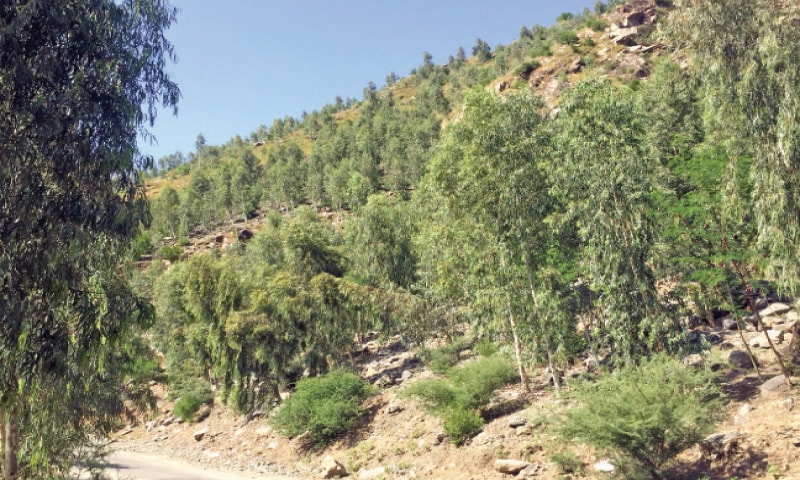

SHANGLA: Trees planted under the government’s flagship afforestation programme in Shangla district’s mountainous range have grown up and started protecting land from erosion and reducing natural disasters like landslides.
Millions of trees have been planted on the mountainous slopes of the district under the Billion Tree Tsunami and 10 Billion Tree Afforestation programmes over the past few years.
It was noted that destruction in the recent torrential rains was less than that of 2016.
The Kohistan watershed department had planted saplings in the BTAP phase-II in Kerai area of Bisham, which was notorious for landslides on the main N-90 Bisham-Swat Road.
These saplings have now turned into fully grown trees and there were fewer landslides in recent rains than past.
Also a tract of land stabilised at Mandawonun area of Shang under BTAP stopped sliding. The District Disaster Management Authority said that the rate of damage in the recent rains was much less than the past.
Trees planted over 9,907 hectares in three phases under BTAP
Abdul Wahab Aurakzai, a geologist at the National Highway Authority, said that for the first time since 2010 flash floods, 95 per cent stretch of N-90 Bisham-Swat Road remained open except at one place where flood had damaged the road in Ranyal area.
He said compared to the past rain-related incidents the damage in the last month’s torrential rain and flood was just 10 per cent as deforestation had been controlled in Shangla.
In Karora area, there had been an active landslide since 2016 flood and rainfall, which caused damage to houses and road blockade, but now after the tree plantation the incidence of landslides has reduced.
“Our houses came under the rubble of a massive landslide in 2016, but afterwards the forest department planted saplings in the area which have now grown into mature trees and the threat of landslide has considerably reduced,” said Tausif, a resident of Karora.
Azhar Iqbal, a resident of Shang, Bisham, said landslides in their area always remained a threat to human lives, but in 2017 on their request the local forest department planted saplings and hired a watchman to protect them and since then there had been no landslides.
Misbahuddin, a wildlife official, said partridges and other birds were now returning to the area due afforestation.
Kohistan watershed department, Shangla, had planted trees over 9,907 hectares in three phases under the Billion Tree Afforestation Project (BTAP) of Khyber Pakhtunkhwa and 309 hectares under the 10 BTAP. As many as 1,075 saplings were planted over each hectare.
The department has also initiated three rainwater harvest schemes and development of three water sources.
Similarly, the forest department, Shangla, planted saplings over 138 hectares in phase-I, 2,620 hectares in phase-II in 2015 and 992 hectares in Phase-III in 2018 under the KP BTAP.
Sub-divisional officer, watershed, Ayaz Ali Shah said that the objective of the afforestation project was to meet needs of firewood and timber for domestic needs, create job opportunities and conserve biodiversity.
Published in Dawn, October 9th, 2020