India’s controversial farm bills become law despite protests

Published September 27, 2020
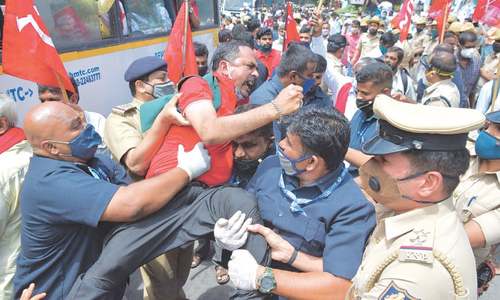
Farmers in India blocked roads and railway tracks in a protest against the legislation that they say could pave the way for the government to stop buying grain at guaranteed prices, leaving them at the mercy of private buyers. — Reuters/File

India’s president on Sunday approved three controversial agricultural bills amid nationwide protests by farmers who say the new laws will stunt their bargaining power and instead allow large retailers to have control overpricing.

Farmers’ organisations say one of the three laws could lead to the government stopping buying grain at guaranteed prices, a move that would disrupt wholesale markets which have so far ensured fair and timely payments to farmers.

President Ram Nath Kovind’s approval is likely to further stir protests, leading farmers’ organisations said.

Prime Minister Narendra Modi has already lost a key political ally from the northern Indian state of Punjab, one of India’s two bread basket states, where farmers form an influential voting bloc.

The country’s main opposition Congress party has also backed the protests.

Under the Farmers’ Produce Trade and Commerce (Promotion and Facilitation) Bill — one of the laws already approved by parliament — growers can directly sell their produce to institutional buyers such as big traders and retailers.

Nearly 85 per cent of India’s poor farmers own less than five acres of land and they find it difficult to directly negotiate with large buyers.

Modi’s administration has clarified that the wholesale markets will operate as usual, and the government only aims to empower farmers to sell directly to buyers.
Follow Dawn Business on X, LinkedIn, Instagram and Facebook for insights on business, finance and tech from Pakistan and across the world.

Opinion

Editorial

Diplomatic resolve
Updated 30 May, 2026

Diplomatic resolve

Iran, too, must engage seriously and provide credible assurances about its nuclear programme if it wants sanctions relief and a more stable relationship with the outside world.
Weaponising water
30 May, 2026

Weaponising water

CLIMATE Minister Musadik Malik’s warning against what he described as “water aggression” indicates ...
Rabies toll
30 May, 2026

Rabies toll

EVERY year, rabies, the deadliest zoonotic disease, kills more than 59,000 people worldwide. In Pakistan, it is one...
Pressure politics
Updated 28 May, 2026

Pressure politics

The attempt to connect the Iran conflict with the Abraham Accords makes little sense.
Eid’s true spirit
Updated 27 May, 2026

Eid’s true spirit

Pakistan celebrates Eid while grappling with economic strain that continues to weigh heavily on ordinary households.
Cotton crisis
Updated 29 May, 2026

Cotton crisis

We need a coherent long-term cotton strategy or else, Pakistan might lose a key pillar of its export economy.