India’s controversial farm bills become law despite protests

Published
1
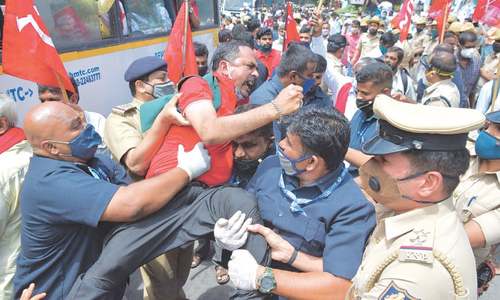
Farmers in India blocked roads and railway tracks in a protest against the legislation that they say could pave the way for the government to stop buying grain at guaranteed prices, leaving them at the mercy of private buyers. — Reuters/File

India’s president on Sunday approved three controversial agricultural bills amid nationwide protests by farmers who say the new laws will stunt their bargaining power and instead allow large retailers to have control overpricing.

Farmers’ organisations say one of the three laws could lead to the government stopping buying grain at guaranteed prices, a move that would disrupt wholesale markets which have so far ensured fair and timely payments to farmers.

President Ram Nath Kovind’s approval is likely to further stir protests, leading farmers’ organisations said.

Prime Minister Narendra Modi has already lost a key political ally from the northern Indian state of Punjab, one of India’s two bread basket states, where farmers form an influential voting bloc.

The country’s main opposition Congress party has also backed the protests.

Under the Farmers’ Produce Trade and Commerce (Promotion and Facilitation) Bill — one of the laws already approved by parliament — growers can directly sell their produce to institutional buyers such as big traders and retailers.

Nearly 85 per cent of India’s poor farmers own less than five acres of land and they find it difficult to directly negotiate with large buyers.

Modi’s administration has clarified that the wholesale markets will operate as usual, and the government only aims to empower farmers to sell directly to buyers.
Follow Dawn Business on X, LinkedIn, Instagram and Facebook for insights on business, finance and tech from Pakistan and across the world.

Opinion

Editorial

Need for dialogue
06 Aug, 2026

Need for dialogue

THE interior minister’s comments at an Islamabad seminar last week have sparked many a conversation about the ...
Bad press
06 Aug, 2026

Bad press

THE government’s move to impose restrictions on international media will not only alienate the foreign press, it...
Automobile concerns
06 Aug, 2026

Automobile concerns

PAKISTAN’S automobile industry is at a critical juncture. Sharp cuts in tariffs on the import of completely built...
State of confusion
Updated 05 Aug, 2026

State of confusion

FROM the looks of it, America has no exit strategy to extricate itself from the disastrous war with Iran. US...
Pension decision
05 Aug, 2026

Pension decision

THE government’s decision to formally operationalise the new Defined Contribution Pension Fund Scheme is a step...
Preventable deaths
05 Aug, 2026

Preventable deaths

THE deaths of 144 children from measles and diphtheria in Karachi during the first seven months of the year expose a...